GAY TIMES April 2001

Terry Sanderson’s autobiography “The Reluctant Gay Activist” is now available on Amazon https://www.amazon.co.uk/Reluctant-Gay-Activist-Terry-Sanderson/dp/B09BYN3DD9/ref=tmm_pap_swatch_0?_encoding=UTF8&qid=&sr=

Although Labour politicians are keeping their fingers crossed that the demands of gay rights campaigners are on hold until after the election, the struggle to establish “the right to a [gay] family life” continues unabated.

Although most “traditional” families usually start out with a marriage – wedding bells, confetti and the vicar maundering on – it’ll be a long time before we’re welcomed into our local church to tie the knot. Nevertheless, individuals keep pushing at the boundaries. Neil Morris and Mark Jinks, for instance, had their relationship blessed on a Valentine’s Day edition of the Richard and Judy Show by ersatz bishop Jonathan Blake.

The ceremony may have brought a tear to the eye of Judy Finnegan, but it brought sick to the throat of many viewers if the following day’s reaction was anything to go by. “Fury as Gays Tie Knot on Richard and Judy Show” bellowed The Sun. It claimed that “telly viewers were gobsmacked” by the sight of the “gay wedding”. Apparently “dozens of outraged fans called The Sun to complain”, but only one was quoted – “mum” Ann Carter of North London. She opined that, “It was totally over the top. It was really creepy.”

Her opinion was shared by Simon Heffer, one of the most barking of The Daily Mail’s resident huffers and puffers, who called the wedding, “this week’s most repulsive stunt”.

He was countered by Lorraine Kelly in The Sun who catalogued the failures apparent in heterosexual relationships before saying: “At least there was some love at the gay wedding. So despite the abuse and scorn heaped on gay couple Mark Jinks and Neil Morris, their gay wedding was strangely refreshing. I wish them all the best”.

Meanwhile, the Mayor of London, Ken Livingstone, was under fire for proposing to spend £100,000 of “taxpayers’ money” to set up “partnership registration” for any couple, gay or straight. The Observer reported: “When the partnership pledge was made, it was envisaged that the facility would be offered only to lesbian and gay couples. However, the Mayor’s advisory group on registration has agreed that the amenity will be offered to all couples.”

The Daily Telegraph reported that “The move is designed to give homosexuals the same rights as heterosexuals and ensure that there are fewer disputes over inheritance, pension rights and tenancies of shared homes. But it is unlikely to have any formal legal standing.”

This is the crux of it, really. What is the point of spending your £25 registration fee for what will be, in effect, the privilege of having your picture taken outside the new County Hall and your worthless certificate signed by Ken. It’s not supportive gestures we need, it’s changes in the law.

Anyway, after you’ve made your vows in front of Ken, you will then want to pop along and start your little family. The Mail on Sunday reported that “Britain’s oldest children’s charity is recruiting gay foster carers to look after the most vulnerable young people in society.”

Apparently the Coram Family (previously known as the Thomas Coram Foundation for Children) is “offering annual salaries of £23,000 to gay men and lesbians to care for young people between 11 and 18 with ‘challenging behaviour’.”

Actually, they are offering £23,000 salaries to all their carers, gay or straight, who are prepared to take on this arduous task, but let’s not get in the way of The Mail on Sunday’s little porky.

The paper admits that the selection procedure – which goes on for six months – is very strict. It includes police checks, home visits, training courses and many interviews. So, it is unlikely that these vulnerable children would end up in unsuitable homes with untrustworthy carers.

But here comes Valerie Riches, of Family and Youth Concern, to say: “Research has shown paedophilia is higher in the homosexual community than in the average male population. These children could be abused by the people who are supposed to be looking after them. Homosexuals may be able to give them the material benefits but cannot give children the moral background to develop emotionally and sexually.”

Over in The Guardian Weekend Magazine, Julie Bindel was saying: “One way the anti-gay bigots seek to poison minds against homosexual men is to label them all child abusers.” She thought that this was “clearly an offensive generalisation” but at the same time “gay men need to ask themselves if they are doing anything to fuel this argument.”

She trawls the archives to come up with evidence that gay men are reluctant to distance themselves from the proponents of “man-boy love”. To back up her case, she goes back as far as the late 70s when the Paedophile Information Exchange gained short-lived support within the gay community. Then she chastises Peter Tatchell for his advocating an age of consent of 14. She tells us that in the 80s some gay men working in social services got away with child abuse because everyone was afraid to challenge “members of the gay community” because of the ethos of “equal opportunities” that gripped local authorities.

She says that blaming gay men for child abuse gives a handy shield to the real abusers – “the jolly uncle or grandfather, using his place in the nuclear family to hide his foul activities.”

Ms Bindel concludes by issuing a challenge to gay men to distance themselves from child sexual abuse by joining forces with those who are actively fighting it. “But”, she maintained, “we cannot escape the fact that, so far, more gay men have attempted to explain the ‘erotic nature’ of intergenerational sex, or shown sympathy and understanding of ‘boy lovers’, than have joined forces with those of us who wish to see an end to child sexual abuse.”

Methinks Ms Bindel is a bit behind the times. Peter Tatchell’s arguments (for those who would listen) were a bit more sophisticated than she credits. He wanted the legal right for young people to have sex with each other, not for them to be abused by older men. So where are these apologists for child abuse within the gay community that she talks about?

Anyway, assuming you can convince the adoption agency that you and your partner are not members of the Sidney Cooke fan club, all you’ve got to do now is sustain and nurture the partnership.

But, just as love and marriage go together like a horse and carriage, marriage and divorce go together like foot and mouth. And already gay couples are finding that splitting up is a much more complicated matter for them than for straight couples. Especially when children are involved.

The Sun reported the case of “A ‘divorced’ lesbian couple” who are “fighting a historic test case over their two-year old love child.

The two women, who had lived together for 12 years, paid £3,700 for one of them to have IVF treatment “believing that a baby would complete their happiness.”

Instead, the couple split up and the birth-mother banned her ex from ever seeing the baby again. Now the rejected partner – a nurse – is fighting in court for the right to see the child. Her lawyer says that: “The couple jointly decided to have the child, and our argument is that they should be treated like any man and wife. It is a very unusual situation, but we don’t see any reason why our client should be treated differently just because of her sexuality. More and more gay couples are having children and it’s a situation the courts will have to look at very carefully.”

There will be painful mud-slinging and recrimination when the case is heard. All very sad, but bound to become more familiar as gay relationships are taken more seriously.

And should you be unlucky enough to lose your partner as a result of murder or other criminal activity, you will soon be able to claim the same £10,000 from the Criminal Injuries Compensation Agency that heterosexual partners can.

Until now, only parents, children, spouses or long-term heterosexual partners of those killed by crime could be compensated, because same sex couples were not recognised by the CICA.

This didn’t suit Norman Tebbit one bit. In the Mail on Sunday he claimed it was just another “favour” granted to Tony Blair’s “favourite people.”

“Same sex ‘partners’ will be given the same rights as married people to compensation if their ‘partner’ is killed,” he wrote. “Of course, brothers and sisters who share a home – but not a bed – will not be treated as generously as homosexuals. What a clear statement of New Labour’s contempt for marriage and family and Blair’s continuing love affair with homosexuals.”

And what a clear statement of Norman Tebbit’s lack of simple human decency and his continuing love affair with bigotry.

And finally, the National Viewers and Listener’s Association, founded in 1964 by Mary Whitehouse, has renamed itself Mediawatch UK.

Nothing to do with me, mate.

GAY TIMES May 2001

Terry Sanderson’s autobiography “The Reluctant Gay Activist” is now available on Amazon https://www.amazon.co.uk/Reluctant-Gay-Activist-Terry-Sanderson/dp/B09BYN3DD9/ref=tmm_pap_swatch_0?_encoding=UTF8&qid=&sr=

In the United States a debate is raging about how gay issues are reported in the mainstream media. It is almost the mirror image of the debate we are having in this country.

While here we complain about the anti-gay bias that tabloid newspapers have traditionally displayed, in the US it’s the other way round. Accusations are flying that the national newspaper and TV outlets have become so politically correct that all negative and critical coverage of homosexuality is filtered out.

It came to a head last month when two gay men, Joshua Brown, 23, and Davis Carpenter, 39, were found guilty by an Arkansas jury of the rape and murder of a 13 year old boy called Jesse Dirkhising. The two men, who were lovers and ran a hair salon together, befriended Jesse’s mother and allowed the boy to work at the salon. They took him to their home, strapped him to a bed, drugged him and raped him repeatedly. The boy eventually suffocated when his tormentors went to get something to eat.

The case was almost entirely ignored by the American media, a fact that whipped up the right-wing opponents of gay rights. They pointed out that when Matthew Shepard, a gay man who lived in Wyoming, was murdered by homophobic bigots, it had become a national scandal. The Shepard case was eventually used as justification for the inclusion of homosexuality in federal hate crimes legislation.

Writing in The Washington Times, a right-wing newspaper with connections to the Moonies, Linda Bowles reported: “The Gay and Lesbian Alliance against Defamation (GLAAD) is an influential organization that lobbies from the outside to influence how the media portrays homosexuality. GLAAD is aided and abetted by the National Lesbian and Gay Journalists Association, which works inside to accomplish the same thing. In an address to these gay journalists last year, Richard Berke, New York Times national political correspondent, boasted that ‘literally three quarters of the people deciding what is on the front page are not-so-closeted homosexuals.’”

From this, Ms Bowles concluded: “the way news is selected and reported exposes liberal media biases not only about race and homosexuality, but about politics, religion, immigration, abortion, education and environment, and gun ownership. Many liberal decision-makers are clearly in the business of censoring out news they do not want the people to see or hear, while amplifying news that advances their undisclosed agendas.”

This, of course, is only one way of looking at these events – and we shouldn’t forget that The Washington Times and its journalists have “agendas” of their own which they are keen to exploit.

Responding in the letters column to the controversy, Chuck Anziulewicz pointed out that the Dirkhising case “is no more a ‘homosexual crime’ than Ted Bundy was a ‘heterosexual rapist/murderer’. If the news media are paying little attention to the fact that the men responsible for this crime were gay, it’s because they didn’t target Jesse Dirkhising because he was gay or straight. The facts surrounding this case indicate that sexual orientation – whether of the perpetrators or the victim – was not a factor… In all the newspaper stories I have read involving men raping and/or murdering women, never once have I seen the word ‘heterosexual’ used. Similarly if the men accused of raping and murdering Jesse Dirkhising were instead accused of raping and murdering a teenage girl, I’m sure you would not be making such a cause célèbre out of it.”

Meanwhile in The Weekly Standard, a sophisticated platform for the religious Right, Mary Eberstadt (a sort of cross between Mary Kenny and Valerie Riches) wrote two long articles alleging that paedophilia is an increasingly prominent part of gay life and is condoned by gay leaders. “The better-known gay organisations,” she wrote, “all of whom stand dead against any conflation of homosexuality and paedophilia, are nonetheless sending out mixed messages about what is and is not off-limits for the under-aged. Most of them, for instance, now have ‘youth sections’ on their websites… the justification for this is to ameliorate the angst of gay teenagers. At the risk of stating the obvious, though, it is hard to see how this purpose is served by encouraging boys to act and think sexually at ever younger ages, which is the unavoidable side effect of the type of ‘outreach’ these sites engage in.”

The even further-to-the-right Jewish World Review agreed, and commented: “The defence of gay paedophilia has metastasised deep and far into the national conscience.”

Over in the New Republic, Andrew Sullivan, who is a gay man himself, branded all this as “ugly nonsense”. He admitted that “paedophilia has always been a vile undercurrent in some gay circles (as in some straight circles)” but “the vast majority of homosexuals are rightly horrified by the sexual abuse of children.”

All the same, Sullivan cannot completely refute the Right’s argument that there was bias involved in the reporting of the Shepard and Dirkhising cases. Checking the media website Nexus, he found that it had recorded 3,007 stories about the death of Matthew Shepard, while there had been only 46 about Dirkhising. “The discrepancy,” he says, “isn’t just real. It’s staggering.”

He comes to the conclusion that there may be some truth in the Right’s complaints of media bias. “The Shepard case was hyped for political reasons: to build support for inclusion of homosexuals in hate-crime law. The Dirkhising case was ignored for political reasons: squeamishness about reporting a story that could feed anti-gay prejudice, and lack of any pending interest-group legislation to hang a story on.”

Which brings us now to the reporting of a case in this country involving a gay man who raped and murdered younger men. Royal Navy Petty Officer Allan Grimson, 42, was convicted last month of bludgeoning to death 18 year old Nicholas Wright and 20 year old Sion Jenkins. There is a strong suspicion that he may have committed several similar crimes that have yet to be uncovered. The British press reported it “straight” as simply as an unusual and lurid court case, although references to his sexuality appeared in most of the headlines (“Gay Slayer”- Sun; “Homosexual sailor killed for kicks” – Telegraph; “Gay sailor given life for serial killings” – Express).

However, there was no added sensationalism in the reporting and no attempt to attach any wider significance to the murders. There were no titillating background features exploring the “twilight world” of homosexuals or any condemnatory editorials telling us that such horrors are an inevitable consequence of our lifestyles. Previous gay serial killers such as Dennis Nilsen and Michael Lupo drove the papers into fits of horror and moral outrage. But not this time.

So does this tell us that the political correctness that allegedly restrains the US press has now found its way into British newspapers? Or is it simply that our newspapers have grown up and no longer see the need to demonise all gay people because of the activities of a few psychopaths and nutcases?

Of course, it could be said that it was, indeed, Allan Grimson’s sexuality that motivated his grotesque deeds. After all, it was some sort of sex he wanted from the young men he eventually battered to death. But, of course, the same argument could be applied to the thousands of women who are annually raped and killed by straight men. And their sexual orientation is never mentioned.

But if the American Right has used these arguments about pro-gay bias with any success, you can be sure that the reactionaries in this country will soon be picking them up and attempting to import them here.

It would be difficult to sustain charges of over-liberality against British newspapers, though – the balance here has always been tipped towards the reactionary. No, the pressure is more likely to be on the broadcast media (particularly the BBC) with renewed charges that its liberalism and ‘political correctness’ are distorting the news agenda.

As the push for hate-crime legislation gathers pace in Britain, and the case for including homosexuals in it is made, we will hear more about the “skewed reporting” of homosexual matters. There will be demands that TV producers (who, according to the likes of Garry Bushell, already represent a Pink Mafia that controls the airwaves) give a more ‘balanced’ portrayal of gay life – i.e. a more negative one.

We saw a small prelude to it when Scotland Yard arrested 56 people in dawn raids throughout London. According to The Daily Telegraph these people were suspected of “hate crimes” such as homophobic harassment and publishing racist and homophobic materials.

In The Daily Mail, Simon Heffer was quickly on the attack: “What about a co-ordinated series of raids to arrest muggers, drug dealers, car thieves and others who prey on everybody and not just on fashionable minorities? Or wouldn’t that play so well with the Metropolitan Police’s cringe-making attempts to ingratiate itself with a government obsessed with political correctness.”

Stand by for blasting.

GAY TIMES June 2001

Terry Sanderson’s autobiography “The Reluctant Gay Activist” is now available on Amazon https://www.amazon.co.uk/Reluctant-Gay-Activist-Terry-Sanderson/dp/B09BYN3DD9/ref=tmm_pap_swatch_0?_encoding=UTF8&qid=&sr=

According to a report recently issued by the Broadcasting Standards Commission, the British public think that “celebrities and politicians who court fame have no right to privacy”, although “the private lives of ordinary people should be respected”.

At the same time, the Press Complaints Commission has received a complaint from a friend of Noel Sullivan, of the band Hear’Say, about a picture that was published in The News of the World showing him embracing the pop star. The Guardian reported that Rebekah Wade, the NoW’s shadowy editor (has anyone ever seen her?) “will have to explain why she allowed an ordinary person to be subjected to the glare of publicity in the pursuit of increasingly salacious stories about Sullivan.”

All of which once again opens up the debate about the outing – or the voluntary coming out – of gay celebrities. How big a hand should the media have in “assisting” those in the public eye out of the closet?

In repressive eras, closetry was understandable. In the tight-arsed fifties, for instance, you kept your sexuality under wraps if you wanted to work (and stay out of prison). So although it was clear to anyone with eyes to see that Noel Coward was gay and so was Dirk Bogarde and Michael Redgrave, there was never any public acknowledgement of it while they were alive. Everyone conspired in the cover up.

When the conspiracy of silence was broken in the sixties, it became more difficult to maintain the fiction. In the seventies and eighties it was harder still, as tabloid newspapers became the sole arbiters of which famous gays would be allowed to retain their secret and which would be outed. Self-hating gays like Russell Harty and Kenny Everett never really recovered from the lascivious revelations about their sex lives that were splattered all over the Sunday scandal sheets.

There was only one way to stop this cruel routine, and that was by pre-empting the Fleet Street outers and doing the job yourself. A new, braver breed of showbiz gays came along, people who weren’t at odds with their orientation. Ian McKellen, Simon Callow, Paul O’Grady and Graham Norton all took the initiative away from the tabloids and did the job themselves. Latest in this line is Radio 1 DJ Scott Mills, 27, who came out last month saying, “The target Radio 1 audience will, I hope, be fine about it.”

Others have tried and been less successful. Michael Barrymore and his Garland-like descent from the summit springs immediately to mind, as does Peter Mandelson and the lesson we can learn from him on trying to be half out and half in.

Generally, though, the mould has been broken. It is now possible to come out in the full glare of the media and not only survive, but thrive. Nearly all those who’ve been honest about their sexuality have gone on to ever greater heights. In fact, the Sunday Times reported that the BBC and ITV are in a multi-million pound bidding war to secure the services of Graham Norton – probably because he is gay.

But despite this climate change, there are still those who can’t quite bring themselves to do the deed.

Speaking to The Daily Express, Dale Winton refused to take the leap. “With an ever ready smile for the camera,” said his interviewer, “Dale has survived his seven years in the spotlight remarkably unscathed, give or take rumours about his sexuality (he consistently refuses to be drawn on whether he is gay)”. Danny La Rue has also come in for stick over his inability to make the leap. The same gossip column quotes a theatre historian, Laurence Senelick as saying: “Everyone in British show business is familiar with his [La Rue’s] sexual predilections… is this masquerade necessary lest he lose the affections of the British public or is his a deeply confused identity?”

It’s not as if he were Sir Alec Guiness, whose career flourished at a time when such revelations would have had a real impact.

Three new Guiness biographies are about to be published, and all reveal that he was arrested and fined 10 guineas for “gross indecency” in a public lavatory in 1946. The Sunday Times told us that the then up-and-coming thespian managed to avoid any publicity by telling the police he was ‘Herbert Pocket’, the name of a Dickensian character he was playing at the time. Guiness was married with a young son when he was fined and it is likely, because of this and his religious faith, that he would have been traumatised by any publicity. We are promised that there are other revelations to come about his life as a tortured bisexual.

The other noted theatrical knight, Sir John Gielgud – who is also the subject of a biography by Sheridan Morley, which was reported in The Guardian – was not so lucky. He failed to come up with a nom de plume when he was arrested and fined for importuning in 1953, and the case was reported on the front page of The Telegraph.

Although he managed to survive it, it was such a devastating event for him that he never mentioned it publicly again – or any other aspect of his private life.

Since he died, though, it has emerged that he lived with another man for 35 years and would make donations to Stonewall on the condition that they were not revealed.

All we need now for the set is for that other member of the great British acting triumvirate, Sir Ralph Richardson, to be revealed as a closet case. But he’s the exception. The Mail on Sunday reported that in a biography, written by Garry O’Connor, there is a suggestion that Richardson completely rejected his son Charles, because he “strongly disapproved” of his homosexuality.

Antony Sher is one of the present-day great actors who is gay. The Sunday Times has been carrying excerpts from his achingly honest autobiography. One of these extracts explored Sher’s relationship with his parents. He decided to come out to his mother in 1973 – her initial reaction was good, but she told him that he must never tell his father. Within a couple of weeks, she had done the deed herself. Sher was anxious about how his father, whom he found difficult, distant and macho, would react. To his surprise, there was a definite improvement in what had been a chilly relationship. But it never became an intimate friendship, something which Sher regrets – “Dear God,” he writes, “heterosexuals are so queer. How can you have a son and not hold him, hug him, kiss him?”

Gay Radio 4 pundit and historian David Starkey, was also reminiscing, again in The Sunday Times – this time about his mother, who pushed him relentlessly to succeed. Eventually he decided that he had to tell her the truth, although he knew she would find it hard to understand. “My mother had begun to suspect, but at first I suppose I had sufficient tact to shield her. But it all came to a head just after I moved to London in the very early days of Gay Pride, and there was that marvellous slogan, which in many ways I still live by, ‘Better late than latent’. Eventually, inevitably I developed the determination to confront my mother with what I was. I said to myself, I’m doing this because it is the honest thing to do, but there was probably a cruelty underneath… The final, terrible, blank hostility after I finished; the banal response: ‘We brought you up to live a proper life. What sort of life is it, that?’ She wanted the world as she wanted it, she wanted 2.4 grandchildren. She could never understand it, and she never got over it. And it was unhealable, because there was no moment at which reconciliation took place, as she died.”

And in politics – which is really a branch of show business now – we have Chris Smith and Nick Brown keeping high profiles. Nick Brown, the lugubrious gay Agriculture Secretary has been thrust to the fore by the foot and mouth epidemic. Failing to be drawn into the hysteria that the press has tried to create, he has kept a steady hand throughout that should do his career no harm at all.

Chris Smith was interviewed at length in The Guardian and revealed something of his own coming out experience. He didn’t really realise he was gay until his early 20s, and then he didn’t tell his parents until shortly before his public statement at a meeting in 1984 to protest about Rugby council’s decision to drop anti-gay discrimination policies. “They lived in Scotland and I was in London,” he says “We never really had chance to have that rather difficult conversation.” He says they were initially concerned but “subsequently they have been wonderful. They always ask about Dorian [Dorian Jabri, his partner] when I speak to them on the phone.”

Chris Smith is now a widely admired politician who has survived some of the worst crises of the first Labour government – the Dome fiasco, the Lottery cock up, the endless wittering about the arts. We can only hope that his skills will continue to be utilised after the election.

These stories, sometimes heart-warming, sometimes sad, indicate how homosexuality has now entered into the consciousness of the nation. And there is no doubt that if you have the requisite talent and necessary bravery, you can prosper as an open gay person in public life.

So remember, gay celebs – better to be honest and retain your dignity rather than waiting for the News of the World to come and get you.

GAY TIMES July 2001

Terry Sanderson’s autobiography “The Reluctant Gay Activist” is now available on Amazon https://www.amazon.co.uk/Reluctant-Gay-Activist-Terry-Sanderson/dp/B09BYN3DD9/ref=tmm_pap_swatch_0?_encoding=UTF8&qid=&sr=

The lethal drink, drug and fame-fuelled roller coaster that is presently being ridden by Michael Barrymore has claimed many show biz victims in the past. Judy Garland, Paul Gascoigne and George Best are three that spring immediately to mind.

Others have taken the ride and survived, most notably Boy George and Elton John, both of whom managed to put on the brakes and recover before it was too late.

So is Barrymore on the way to becoming a tragic Judy or an heroic Elton? Is he at the end stage or the mid stage of his story?

We will have to wait and see, but worry not – the tabloids will ensure that we have a ring-side seat for every stage in what will either be a miraculous recovery or a tragic finale for the “troubled star” (as he is now invariably described).

Certainly no detail has been spared of the story so far. Courtesy of the News of the World, the Sun and the other red tops, we have followed Barrymore through his various struggles with drink, drugs, fame and homosexuality. His career has been written off repeatedly, and yet he has somehow managed to revive it on each occasion.

But this time it’s different. A young man who had been sexually ravaged in violent and sickening ways by multiple partners was found floating in Barrymore’s swimming pool after a wild party. The police suspect murder. Can even bouncy Barrymore recover from such a scandal, even if he wasn’t directly involved?

There has been enough conjecture about what has caused this once-loved performer to fall into such ruinous disgrace. His unhappy childhood, his struggle with his sexuality, his inability to cope with celebrity, his addictive personality and the kinds of people he has chosen to consort with.

All these things are likely to have played a part, but were any of them the prime motivator in his present degradation?

Was, for instance, his prolonged and messy coming out the trigger that sent him over the edge? After all, while they were married, Cheryl had kept him under a tight rein. His tendency towards impulsiveness, addiction and poor judgment were controlled by her cooler head.

But when the marriage ended, it was downhill all the way. His lack of self-control, his almost maniacal hedonism and his many other problems plunged him into a vortex of cocaine, pills, booze and reckless sex.

For a while it seemed he had found his saviour in Shaun Davis, a young man who cared for him. But he was driven away reportedly by Barrymore’s chaotic, coke-fuelled lifestyle.

Those who stepped in to fill the emotional vacuum were the very people Barrymore should have run a mile from. They were, as one commentator put it, “more concerned about how much white powder he had in his pocket than they were about him.”

His last boyfriend, John Kenny, sold the story of their relationship and what had happened on that fateful night to The News of the World. After that, he revealed to The Sun that he was HIV positive – something he hadn’t told Barrymore until their relationship was over.

So, was homosexuality the cause of Michael Barrymore’s downfall? After all, he wouldn’t be the first gay man to have buckled under the strain of a double life.

Most of the Fleet Street’s self-appointed experts were sure that his sexuality wasn’t to blame.

Carole Malone – a graduate with honours from the Glenda Slagg school of journalism – wrote in The Sunday Mirror: “I am finding it increasingly hard to stomach the endless stream of stories about Barrymore’s pain, his tortured life and his demons…. His career is all but finished and everything that finished it is his fault. So let’s stop all this twaddle about all his problems being down to him being a repressed homosexual in a loveless marriage. Let’s stop portraying him as a tortured soul bereft of any of life’s advantages. Because he had ‘em all – and he blew it.”

Lorraine Kelly in The Sun agreed: “It has nothing to do with him being gay but everything to do with his lack of self-control and self-respect.”

In The Daily Mail, under a picture of Barrymore and the headline “Is this man now beyond the pale?” David Thomas wrote: “Homosexuality is not the source of public disgust. Had the body in the pool been that of a young woman, our horror would have been just as great, perhaps even greater.”

In The Times Nicholas Wapshott said: “To come out as gay was once considered the most damaging revelation for an entertainer. But no more – in Britain at least. The television screen is littered with camp comedians – Julian Clary, Lily Savage and Graham Norton – and, as with Kenneth Williams and Frankie Howerd, the British public does not care a damn about what they are up to in private so long as they make us laugh.”

Naturally there were others who tried to exploit the Barrymore debacle to push forward their own nasty agenda. Simon Heffer, the deeply unpleasant right-wing columnist on The Daily Mail wrote: “It was revolting to read details of the allegations made against Michael Barrymore and his friends, and even more revolting to be told of the physical state of the young man found dead in his swimming pool. When members of our liberal tendency read of this sort of horrible activity, are they still so smug that, thanks to them, such bestiality can now be inflicted on children of 16?”

And so, Barrymore rushes off to another clinic, this time in Arizona, looking for the miracle cure for his problems. You’d think experience would tell him that therapy doesn’t work for his kind of troubles in the same way that a shot of penicillin works for the clap. It actually takes a lot of determination and will power to beat addiction, but first of all it takes a willingness to even want to try.

So, if it wasn’t homosexuality that did for Michael Barrymore, was it his inability to cope with the level of fame and recognition that he has achieved? As Lynda Lee Potter (queen of the Glendas) wrote in the Daily Mail: “He’s complained bitterly about the pressures of success. He may well find the pressures of failure are even harder to bear.”

Bryan Appleyard in the Sunday Times examined Barrymore’s relationship with his “adoring fans”.

He quotes Michael as saying “It’s very difficult to have a relationship with millions of people. They know me, but I don’t know all of them. I’ve lost count of the number of times I’ve tried to discover the real me”.

To this, Appleyard retorts: “Let us be clear about this: there is no ‘real self’, no ‘child within’, no ‘real me’, no authentic essence somehow concealed beneath some malign combination of drugs, sex, fame and money. There are only people who live and people who just talk about it. The latter are all sick and quite a lot of them are rich and famous. There is something about the process of suddenly finding themselves known, watched, adored and wealthy that flings certain people into futile paroxysms of psycho-babbling narcissism”.

More likely, says Appleyard, what stars who go off the rail really cannot handle is that they are freed from constraints such as lack of money or serious disapproval. “Barrymore could have all the sex ‘n drugs ‘n easy listening he could handle. Barrymore plunged into that distinctive form of contemporary nihilism which, for some reason, is known as having a good time or, more accurately, ‘getting wrecked’. Why not? There’s nothing else to do, no other reason to live.”

Appleyard then goes on to berate those public figures who have fallen into this trap of imagining that they are not doing these terrible things to themselves, but that somehow things are being done to them, and that their real self has been buried by this false sense of celebrity.

He advises those self-regarding celebrities such as Barrymore to exhibit a little more decorum, to take responsibility for themselves and “seek salvation in the real world not in the fantasy land of therapy and expensive clinics.”

So, are we any nearer to knowing whether it was his gayness, his fame or simply an inability to control his impulses that brought Barrymore low?

It was probably a combination of all three. Many people who wait until later in their lives to start to explore their homosexuality find that, after decades of denial, it isn’t so easy to shrug off the accumulated self-hate. And a young man from a modest background with little education who is suddenly plunged into the world of celebrity and adulation would find it a struggle to keep a handle on reality. But most of all, I think it was his embracing of the now widely-held philosophy that if you want to do it, do it and bugger the consequences.

Maybe it’s time for all of us to look at the way we are living and question the assumption so prevalent on the gay scene that unrestrained hedonism and self-indulgence is a desirable or adequate lifestyle.

Gay Times August 2001

Terry Sanderson’s autobiography “The Reluctant Gay Activist” is now available on Amazon https://www.amazon.co.uk/Reluctant-Gay-Activist-Terry-Sanderson/dp/B09BYN3DD9/ref=tmm_pap_swatch_0?_encoding=UTF8&qid=&sr=

Michael Portillo’s long game is now reaching a critical phase, and one wonders whether he still has the stomach for it. There is something about his public persona that seems rather detached and distracted. He seems reluctant to talk, and gives away the absolute minimum about his thoughts and feelings.

This may simply be a politician’s ploy, based on the maxim “least said soonest mended”. Perhaps he now realises the value of keeping schtum, having been caught out so many times by wily journos who led him up the garden path only to dump him in the fish pond.

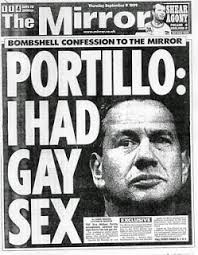
Mr Portillo realised that if he wanted to achieve his ambition of becoming leader of the Conservative Party, he would have to expose to public gaze that rather large skeleton rattling in his closet. Consequently he made his admission about youthful dalliances with homosexuality and hoped that that would be the end of it. He gambled that people would admire his honesty and take him to their hearts as they have done so many other gay people in public life who have done the brave thing.

The liberals in our society would gladly have done that. The Independent – that standard-bearer of everything that is fair and just – editorialised: “Mr Portillo has been congratulated on his openness about his past homosexuality, and rightly so, but only on the assumption that it might help lead to a situation in which such information was a matter of indifference… If the Conservative Party really is to reach out to a new bloc of voters, it must put prejudice and homophobic innuendo behind it. As the once-influential Bow Group says, it must tone down its support for that symbol of discrimination, Section 28. And no more should be heard from within the party’s ranks about Mr Portillo’s private life. Let the candidates for the Tory leadership be judged on their merits and their merits alone.”

Unfortunately, the Independent does not have much influence in Tory circles and Portillo’s case wasn’t helped much when news emerged that another former lover had died from Aids. Francois Kervan died in Madrid on 8th June. Another lover, Nigel Hart, died in 1999.

After he had made his admission, someone asked if he regretted it. “I was keen to put to rest the rumours that had been circulating about me… I don’t think it was a particularly big burden but I don’t have any regrets. The truth is a good thing” he said.

Ah yes, but now we come to the philosophical point: what is truth in this context?

Jaded hacks have been quick to notice the inconsistencies in Mr Portillo’s tale, and who can blame them for being cynical when the man himself gives the impression that he’s deliberately creating smokescreens. Such a manoeuvre never works with the press.

So, although Mr Portillo had hoped to lay the gay ghost by opening his closet door just a crack –giving the world a tantalising glimpse inside before slamming it shut again – he has actually ended up by fanning the flames of scepticism.

And the consequence is that THE question keeps being put, and Mr Portillo has to find new and elaborate ways of not answering it. Matthew D’Ancona in The Sunday Telegraph asked Portillo if he was certain that there was nothing else to come out about his gay past. “I’ve said that any number of times,” Portillo replied.

“But just for the record, can you restate your position,” persisted Mr D’Ancona. To this our hero retorted: “I will say it again. I do say it again. I have always spoken the truth.”

Then Mr D’Ancona asked if Mr Portillo thought, given the more tolerant age in which we live, that his opponents’ attempts to use homophobic innuendo against him might backfire, “The danger is that if I answer your question, I get led into what I don’t want to do,” was the enigmatic reply. What on earth can it all mean?

David Frost didn’t fare much better when he asked Mr Portillo if he had any homosexual experiences since his marriage in 1982 (Breakfast with Frost BBC1). “I have been completely straightforward about this” said the evasive shadow chancellor. “I don’t think any politician has been as straightforward as I have been. I have nothing to add to that.”

So was that yes or no?

And does it matter, really? An ICM poll conducted by The Daily Mail asked: “Michael Portillo has admitted to a gay past. If selected as party leader, how would this affect ordinary voters?” 37 per cent thought it would count against him. 1 per cent said it would count in his favour and 59 per cent thought it would make no difference.

The Times reported: “Other polls have shown that a majority of the public has a generally permissive attitude to personal lives. This is not necessarily a guide to the view of Conservative party members.”

In The Daily Telegraph, arch-Tory Tom Utley wrote: “I have a suspicion that his past will count against him with unsophisticated, non-metropolitan Tories… It will be jolly interesting to see.”

Indeed, the straw polls conducted by the papers among Tory voters – who will make the ultimate decision as to who will be their new leader – have shown an awful lot of intolerance. All this talk of reform in order to make the party more welcoming to minorities does not play well in the provinces. The Daily Telegraph sounded out opinion in the bar of the Cavendish Hotel in Keighley, West Yorkshire.

Paul Smith, a window cleaner, said: “I’ve voted Conservative all my life, but there’s one guy who if he got it I’d seriously change my vote. I don’t like his arrogance. Basically I don’t like him because he’s actually come out with it that he’s gay. I don’t like things like that. It’s against all moral standards in my eyes.”

Others said they didn’t mind Mr Portillo’s sexual history, but weren’t taken with his big lips.

The Times contacted the chairmen of 60 Conservative constituency parties and asked for opinions about his sexuality. More than a third thought the revelations would damage his chances.

John Kennedy of Beaconsfield replied: “Mr Portillo’s statement about his homosexuality did not help at all. It put a lot of people off… I am perfectly happy for people doing what they want behind closed doors but I don’t want them waving it about in public.”

Lady Fry of the Wellingborough association wanted to know whether there were any more skeletons to be brought out, as did Neil Stocks of Colchester. Bryan Hobson of Shipley opined: “There are certain people who did blanch at his statement and will never forgive him for it. But people have had much worse peccadillos than that.”

The overwhelming fear among those questioned, and one that Mr Portillo is doing nothing to allay, is that all the cards are not on the table.

Indeed, a small item in the “Scurra” gossip column in The Daily Mirror fuelled these fears. It said: “As he previously denied having any gay relationships since university, this appeared to mean that this phase of his life was behind him. So why is a Sunday newspaper spending so much effort in tracking down a 43-year old Surrey-based pilot believed to have been a close friend of the Tory leadership contender?”

You can be sure that the tabloids will be sparing no expense in their renewed effort to break through Mr Portillo’s enigmatic denials.

The Times thought that Michael Portillo was caught in a trap. Every time he talks about the Tories becoming more “inclusive” it is interpreted as “banging on about gays”.

“No one, though, said the same of John Major when he said the party needed to drop its censorious moral tone, show more tolerance and judge people less,” said the paper. “Was it because Major, in Lord Tebbit’s loaded description of Iain Duncan Smith, one of Portillo’s rivals, is a ‘normal family man with children’?”

Meanwhile in the Sunday Telegraph, Gyles Brandreth was exploring the long relationship between “the love that dare not speak its name” and the Conservative Party. “Many Conservatives, especially on the right of the party, are revolted by homosexuality,” he wrote. “And many Conservatives, especially on the right of the party, are homosexual.”

From then on, every idiotic stereotype pertaining to homosexuals was paraded for the pleasure of Sunday Telegraph readers. Naturally, in Brandreth’s world, gays are all Thatcher worshippers. Peter Just, of Politicos bookshop – himself a gay man – says: “We adore her. She’s wonderful. So camp, so gorgeous in her Aquascutum suits. We are grateful for her achievements when she was Prime Minister and now we just love the drama of her every appearance.”

According to Brandreth, gays are all naturally right-wing – look how many homosexuals there were in the Nazi party, he says. The theory seems to be accepted by an increasingly idiotic Ivan Massow. “It’s a matter of extremes,” the great sage-cum-insurance salesman is quoted as saying. “It’s camp. It’s over the top. And, of course, if you want to go to the far Right, there’s an element of Aryanism. I am right, aren’t I?”

Maybe about yourself, Ivan, but leave me out of it.

Gay Times September 2001

Terry Sanderson’s autobiography “The Reluctant Gay Activist” is now available on Amazon https://www.amazon.co.uk/Reluctant-Gay-Activist-Terry-Sanderson/dp/B09BYN3DD9/ref=tmm_pap_swatch_0?_encoding=UTF8&qid=&sr=

Very soon, Mr Blair will have to make a tricky choice between two of his pet issues, and whichever choice he makes, he’s going to unleash a storm of resentment and resistance.

The issues are homosexuality and religion. As we have seen in recent debates, the two seem utterly incompatible. If gays get anywhere near gaining equality, religionists immediately begin agitating to retard progress. As Mary Riddell in the Observer said: “Whenever the abolition of Section 28, or biotechnology, or gay sex at 16 is at issue, a gaggle of apoplectic archbishops proffer brimstone and damnation.” We’ll see much more of this in the forthcoming battles on partnership and employment rights.

For instance, last year the European Union approved a directive that obliges member states to enact legislation within three years that will give citizens protection from discrimination in employment on grounds of age, sex, religion, disability and sexual orientation.

Religious lobbyists fought hard in Europe to have the protection for gays watered down. They wanted religious organisations to retain the right to refuse employment to homosexuals. Active homosexuality, they said, was incompatible with their beliefs.

There will be similar sustained bombardment from the religious lobby when this new legislation is considered by Westminster. Organisations like the Christian Institute and the Evangelical Alliance say they don’t want religious bodies to be “forced” to employ gays and lesbians in hospitals, schools, care homes and other welfare organisations that they operate.

The Government is going to have to make a choice. Either gay people get complete protection from discrimination, with no ifs or buts, or they get partial protection, with the religious bodies given a free hand to refuse employment on the grounds of sexual orientation.

If MPs choose the former option, the religious lobby will create an enormous fuss. If they choose the latter, gay people will be outraged and rightly demand full equality (“partial equality” being surely an oxymoron). And for those who think it is OK for Christians, Muslims or Jews only to employ their own, let us not forget that church schools employ tens of thousands of teachers at public expense. The law of averages dictates that some of them must be gay. Will it be OK simply to sack them from jobs? Will it be OK for church schools to put at the bottom of their recruitment advertising “We are an equal opportunity employer – but gays need not apply”? And what about the new Muslim schools that are being proposed by the Government? Can you imagine how a gay teacher would fare in such a place – and how would the Government try to enforce his or her rights in the face of religious bigots who want to stone us to death?

At the same time, pressure is coming from some religious sources for more public funding for faith-based welfare. The Reverend Steve Chalke has started a campaign called “Faith Works” which is lobbying the Government to ensure that faith-based religious charities are not “discriminated against” when taxpayer’s money is handed out. Mr Chalke argues that many churches run welfare facilities, such as old people’s day centres and homeless shelters, and they don’t always get public money to do it. He says that as soon as local authorities realise that religion is involved in the provision of these services, they lose interest and shut their coffers. “Many churches are revealing a picture of having to battle against extraordinary odds to win support from local government,” he told The Church of England Newspaper.

What Mr Chalke doesn’t say, though, is that many of these charities have discriminatory employment policies and some have even refused to provide services to gay people. This is often the reason local councils, with their strict equal opportunities policies, won’t fund them.

The Lesbian and Gay Christian Movement uncovered several cases of injustice against gay people carried out by religious welfare groups. For instance, St George’s Crypt Centre in Leeds is a church-run charity for the homeless. Its “equal opportunities” policy stated that it would not employ, among others, homosexuals, adulterers and those involved in occult groups. Evangelical Christians run the Clarendon Street Shelter in Bedford, a hostel for the homeless. They told two of their clients, Michelle Bates and Amanda Grove, that they would have to end their lesbian relationship or be barred from the facility.

This kind of small-minded prejudice and discrimination is widespread in religious organisations. And they want the right to retain it, enshrined in law, when the new legislation comes forward. It is at that point that the Labour Government will find itself between a rock and a hard place – which will they choose, the rights of homosexuals to be free from unfair employment practices or the “rights” of religious groups to sack innocent people from their jobs?

North of the border, where the Church of Scotland is the largest provider of welfare in the country, this discriminatory attitude is particularly strong. Ann Allen, convenor of the Church of Scotland Board of Social Responsibility told The Church of England Newspaper: “All our work is done in the name of Jesus Christ, so those who work in his name have to know him.” This certainly means that atheists can’t work for the Church of Scotland, but it might also mean that “practising” homosexuals can also be considered to have turned away from God, and therefore not be worthy of employment.

Thankfully this view is not universally shared. In the July issue of Life and Work, the magazine of the Church of Scotland, the Reverend Ewan Aitken of Edinburgh writes that discriminatory employment policies operated by religious groups are “insanity” because they damage the “credibility and thus the ability of all churches to be at the heart of the many initiatives to get beside some of the most vulnerable people in society (or not in society, actually).”

Mr Aitken argues that “Jesus did not discriminate. He loitered with those discriminated against by others… If we then, in our structures and policies, exclude these folk from being part of our work, then we fail to loiter. We simply patronise and reject again.”

We can see a little of the trouble ahead if we look at what is happening at present in the USA. There, George W Bush was elected on a promise that America’s welfare system would all but be handed over to religious charities. Billions of dollars would be provided for the purpose, he said. This was the new thinking – to which Mr Blair also apparently subscribes – that partnership between church and state is the way ahead in relation to social welfare.

But almost as soon as Mr Bush had made his proposals, objections arose from a whole raft of civil liberty and human rights groups. Would the religious groups being offered this massive injection of cash be required not to discriminate? Many of them said they’d rather not have Government money if it meant they had to employ homosexuals or adulterers or non-believers. And how would a “faith based” group be defined? Would radical separatist groups like Nation of Islam qualify? Or those that oppose rights for women or minorities? Is Scientology included, and Hare Krishna and the Moonies?

A huge campaign of resistance arose, but despite this, the faith-based welfare initiative – Charitable Choice as it is euphemistically called – has passed its first legislative hurdle by being approved by the House of Representatives. It still has a long way to go, and is being modified in order to make it more acceptable to the Senate. Mr Bush is anxious to reassure doubters that discrimination will not be institutionalised through this legislation, but at the same time the Guardian reported that “The Bush administration was accused of plotting to allow federally funded American religious organisations to discriminate against gay men and lesbians. A spokesman for [the President] denied a report in the Washington Post that the White House had made a ‘firm commitment’ to allow the Salvation Army and other religious charities to discriminate against gays. But it did not deny claims that it was discussing ways in which charities can continue to discriminate while they receive millions of dollars in federal aid under Mr Bush’s ‘faith based’ social services plan.”

While this was happening, a significant case was heard in Kentucky, concerning a woman who had worked for a Baptist children’s home, but who had been fired when it was discovered she was a lesbian. In its firing notice, the Baptist church said: “Alice Pedreira is being terminated from Kentucky Baptist Homes for Children because her admitted homosexual lifestyle is contrary to Kentucky Baptist Homes for Children core values.”

With the help of the American Civil Liberties Union, Alice Pedreira had challenged her sacking in the District Court. Last month, the Judge ruled that the Baptists did have the right to sack her. “The civil rights statutes protect religious freedom, not personal lifestyle choice,” he told The Courier-Journal newspaper.

Although the Baptist Homes receive 80% of their funding from the public purse, they will not be required to amend their employment policy and can continue to exclude gay people from employment and sack those employees they subsequently discover to be gay.

“This is shocking stuff,” said Eric Ferrero, a spokesman for the lesbian and gay rights project of the American Civil Liberties Union. “We now have a court saying that you can use taxpayers funds to discriminate, and that is perfectly legal. It ups the ante on the Bush faith-based initiative and sets off alarm bells.”

Could this kind of crude religion-inspired persecution of gay people happen here? Let’s not forget that the Labour party manifesto included the promise: “We welcome the contribution of churches and other faith-based organisations as partners of local and central government in community renewal. We will use a successor to the Lambeth Group to look at the government’s interface with faith communities.”

The pressure is really on – not only from the loopy Steve Chalke, but also from the Conservative Christian Fellowship. I was invited recently to debate with one of the CCF’s representatives about this very issue on GMTV. It was clear that the religious lobby has an almost open door access to Downing Street. Mr Chalke himself – who was, bizarrely, chairing this debate – has, according to The Times, made two visits to Number Ten to push his case for public money to go to religious initiatives. When I raised the point about discrimination, the man from the Conservative Christian Fellowship didn’t seem to have thought of it. “I’m sure it wouldn’t happen,” he said. So I pointed out the two cases I’ve mentioned above. He seemed unperturbed.

But the Conservatives don’t matter in this case. It’s the Labour party who will be pulling the strings, and there is increasing concern about the Christian domination of the Cabinet. Speaking on the BBC1 current affairs programme On the Record, Martin O’Neill of the trade and industry select committee said of Mr Blair’s overtures to religious charities: “We could be in danger of reinforcing social divisions in the name of alternative forms of provision.”

Let’s hope that when battle commences, Stonewall and the other gay rights groups are ready for the fray. Fasten your seat belts, it could be a bumpy ride.

GAY TIMES October 2001

Terry Sanderson’s autobiography “The Reluctant Gay Activist” is now available on Amazon https://www.amazon.co.uk/Reluctant-Gay-Activist-Terry-Sanderson/dp/B09BYN3DD9/ref=tmm_pap_swatch_0?_encoding=UTF8&qid=&sr=

There are high hopes that Ken Livingstone’s charming gesture to inaugurate a “partnership register” in London will, in the fullness of time, lead to something a little more legally meaningful. Even if the certificate that comes with the registration has no official significance, at least the launch put the whole issue of gay partnership rights firmly on to the agenda.

Surprisingly, there was little resistance on the day. In fact, from some right-wing sources, there was an element of grudging good will, and recognition of the injustices. Even Richard Littlejohn, The Sun’s self-regarding “star” columnist, headed one of his outpourings “Why I’m backing gay weddings”. Mr Littlejohn said that he expected the “wedding” of Ian Burford and Alex Cannell (who were first in the queue) to make him squirm with embarrassment, but to his surprise he found it “rather sweet and touching. And not the slightest bit offensive.”

Mr Littlejohn – and we have to listen to what he says, I suppose, because he is a leading light of that ugly rump of ill-informed bar room opinion that seems to pervade much of Britain’s printed media – catalogued the petty discriminations and humiliations that can attend gay relationships. “Why should a homosexual be denied visiting rights when his partner is seriously ill in hospital?” Littlejohn rightly wanted to know. “Why should a man who has lived in a council flat for donkey’s years be evicted when his partner dies, simply because his name was not on the rent book? Why should a lesbian have to go to an industrial tribunal to get the same employment benefits as a married colleague? People should be able to transfer their pensions to someone with whom they have been in a long-term relationship, married or otherwise.”

The Daily Telegraph’s equivalent of Richard Littlejohn – the ridiculous Tom Utley – also felt that the partnership register was “right”, but for the wrong reasons. “At first I was against the register,” he wrote, “believing it would cost me money through my council tax. But even that charge will not stick. At a hefty £85 per entry, the register looks like becoming a nice little earner for the Greater London Authority.”

As far as Mr Utley is concerned, the whole thing is about money. He’s happy if the certificate can help persuade those who practise discrimination against gay couples to be a little less hard, but he is not happy about the equalisation of inheritance tax and pension rights. “Here, we are talking about big money, and we cannot afford to be sentimental… To put it bluntly, the state has a strong vested interest in promoting heterosexual marriage – but almost none in seeing that homosexual couples stay together. The state needs a constant supply of well-adjusted and law-abiding children – and countless studies show that marriage offers the best conditions in which to produce them. The state does not need homosexual partnerships.”

Mr Utley concludes by saying that churchmen will be ritually shocked by Ken Livingstone’s symbolic register: “We all know that God disapproves of homosexual acts,” he says, “so let us leave God out of this, for the moment.”

If only we could. The plain fact, however, is that when Lord Lester’s and Jane Griffiths’ proposed private members’ bills are introduced into the Lords and the Commons, there will be a general uprising from the religious establishment, who will be claiming breach of copyright on something that they consider to be exclusively theirs – namely, matrimony. They will see it as their duty to man the barricades in defence of “traditional marriage” and fight the introduction of any compassionate, progressive change in the law. Valerie Riches of Family and Youth Concern (a woman not noted for her kind-heartedness in public) started the ball rolling when she told The Daily Mail: “It’s a move towards making themselves socially acceptable as married couples and I don’t think it’s possible. It is another attempt to undermine the whole concept of marriage.”

This has been the story in all the Europe countries that have attempted, and sometimes succeeded, in introducing their particular variation on this partnership theme. The religious have resisted and protested every step of the way. At present in Austria, the Church has been riven by a suggestion that gay relationships might be blessed on hallowed ground. The Catholic weekly, The Tablet reported that: “Influential branches of the Austrian Catholic Men’s Association have distanced themselves from its recent proposal for a special church blessing for gay couples. According to the Association’s Vienna and Salzburg branches, the controversial proposal, which was rejected by the bishops’ conference, was published without consultation and ‘contradicts church doctrine’.”

At the same time, the Calvinist Church in Austria is in favour of gay blessings and has published a list of churches where this is possible. The Lutherans haven’t decided on the issue, out of “consideration for conservative Lutherans”.

Then The Guardian reported that England’s Roman Catholic primate, Cardinal Cormac Murphy O’Connor, had stepped in to stop the blessing of a long-term gay relationship. It was being conducted by Right Reverend John Crowley, Catholic Bishop of Middlesbrough, who was set to say mass to celebrate the 25-year partnership of Julian Filochowski, the director of the Cafod aid agency, and Martin Prenderghast, former director of the Catholic Aids Link charity. The Cardinal rang moments before the service was to begin and forbade it. The Vatican is now, in its inimitably sinister way, “investigating” the bishop of Middlesbrough.

But, according to research conducted by Alan Bray, author of a soon-to-be published book called The Friend, church blessings for same sex couples were quite common between the 14th and 19th centuries. According to a report in The Guardian, there are lots of commemorative gravestones and memorials around the country which indicate that two people of the same sex were buried together in respect for the relationship they had when they were alive. “In Merton College Oxford, a brass dating from the 14th century records the burial together of John Bloxham and John Whytton, showing the two figures standing side by side holding hands in prayer,” reports Stephen Bates, The Guardian’s religious correspondent. “Another dating from 1684 in Christ’s College chapel, Cambridge, celebrates the ‘connubium’ or marriage of John Finch and Thomas Baines, illustrated by a knotted cloth. Nearby in Gonville and Caius College chapel a memorial of 1619 commemorates Thomas Legge and John Gostlin with a flame uplifted by two hands with a Latin inscription which translates as: Love joined them living. So may the earth join them in their burial. O Legge, Gostlin’s heart you still have with you.”

But lest we get the impression that gay partnerships were common and approved of in days of yore, we have Andrew Carey – son of the Archbishop of Cant. – pouring cold water on the idea.

He writes in The Church of England Newspaper that journalists are trying to paint “these friendships as equivalent of modern-day homosexuality”. They were nothing of the sort, he insists, and “spiritual kinships” of this kind were not sexual and the participants were not “married” in any recognisable sense.

“The Church has always regarded marriage as the pinnacle of God-ordained relationships. The self-identity of gay Christians cannot be read back into history in any kind of straightforward way,” Mr Carey opines. He says that the search for antique evidence to justify modern causes “must be resisted if we are not to corrupt the study of history completely”.

Excuse me? But isn’t the Christian church famous for repeatedly rewriting history to its own advantage? We don’t need lectures from Christians about perverting history – they are the past masters!

The fact is, though, that when the issue comes before Parliament, Lady Young will be gently prodded back to consciousness, and battle will commence. I can imagine that the propagandists at the Christian Institute are already writing her speeches and concocting another of their slanderous pamphlets that will be called something like “Gay Marriage: the end of all Christian life as we know it and the final insult to all God-fearing people, amen.”

But gay “marriage” is not what we are asking for. Nowhere (except in lazy newspaper headlines) has anyone asked for “marriage”. We want partnership rights, plain and simple. Let heterosexuals keep their blessed, misery-making institution for themselves. And let gay Christians fight a separate battle for the right to celebrate their unions in church. We cannot wait another century for the Pope to change his mind, and the Archbishop to relent in his opposition. We need legal protection, and we need it now.

In the meantime, we have to go at it piece-meal, fighting each issue separately. The Observer reported that “Armed forces plan to give gay partners full married benefits”. Such an approach simply creates discrimination, as those outside the armed forces are denied these benefits.

Let’s thank Ken Livingstone for getting the debate started, but let us also not underestimate what lies ahead. The Independent was quite clear that it doesn’t see much scope for progress in the near future – “such a prospect still appears a long way off” it said. But that doesn’t mean that we should not press on with optimism.

So let’s don our battle fatigues once more, roll up our sleeves and make “pretend family relationships” very much into legally-recognised real ones.

GAY TIMES November 2001

Terry Sanderson’s autobiography “The Reluctant Gay Activist” is now available on Amazon https://www.amazon.co.uk/Reluctant-Gay-Activist-Terry-Sanderson/dp/B09BYN3DD9/ref=tmm_pap_swatch_0?_encoding=UTF8&qid=&sr=

On September 10, I was writing a letter to the Egyptian Ambassador in London, protesting at the trial of 52 men in his country who were charged with various homosexual offences. This was obviously a show trial, I said, and it is clear (see last month’s Gay Times for details) that many of the men aren’t even gay, and are simply sacrificial victims, apparently chosen at random, to create a diversion from the country’s financial woes.

Then there was September 11.

A few weeks after this catastrophe, we were told by our Prime Minister that Islam had nothing to do with it. The people who did it were simply ‘terrorists’, not ‘Islamic terrorists’. Then he went to Pakistan in order to create a coalition with a nation that, only days before, had been regarded as a pariah to decent people and a grotesque abuser of human rights, and he assured the leaders of that country that Islam is a peaceful and glorious religion.

A recent issue of The Pink Paper examined the approach to homosexuality in leading Islamic states. The catalogue of cruelty, murder and persecution of gays was second only to their abuse of women. But we aren’t allowed to place the blame where it truly lies – at the door of Islam.

And even as I write, a news story comes down the wires, taken from an Iranian daily paper called Entekhab, saying “Iran’s government has ordered police to stamp on gays, who it claims are a sign of ‘western depravity’, and on women who are ‘unIslamic.’ Police have been told to close down internet providers who allow gay sites as well as internet cafes frequented by gays.”

Then at the Labour party conference, Home Secretary David Blunkett promised British Muslims that legislation would be rushed through making “incitement to religious hatred” illegal. He did this because Muslims in this country are being threatened and beaten up in the street in the wake of the World Trade Centre attacks.

I feel very sorry for those innocent people who are being violated and intimidated because they are Muslim. My sympathy arises from direct experience of being subjected to random violence and harassment from strangers in the street. I sympathise because last month a friend of mine was queer-bashed so badly that he had to spend two days in hospital. I sympathise because two straight colleagues of mine who were on their way to a party together were mistaken for “batty boys” and, for no other reason, were given a good kicking by a gang of strangers.

We in the gay community know what this kind of arbitrary violence can do to both body and mind. Let us not forget that the bomb that went off in the Admiral Duncan pub was an act of terror aimed at gay people, by a man filled with seething hatred that must have been incited somewhere – probably on some fascistic website. So why aren’t we getting protection from incitement to hatred?

After all, there is enough anti-gay hate mongering around. We are subject to casual abuse from many different sources. Tabloid newspapers sometimes vent their hatred of us in unrestrained terms. And so do religious zealots. One has only to remember the campaign waged in Scotland by Brian Souter and Cardinal Winning, and the violence that flowed from it, to realise that Muslims are not the only ones who need protection.

The race relations law has done little to stop racist violence, but it has stopped racist groups being able to publish inflammatory material advocating that violence. I’m all for that. But how would that work in relation to religion? Would the new law be protecting people, or their ideas?

Perhaps it was The Daily Telegraph that best summed up the dangers in an editorial. “It is important to be clear what Mr Blunkett is putting forward. Incitement to criminality has always been illegal. When person A persuades person B to attack person C, person A is breaking the law. What makes the race laws different is that person A can be convicted on the basis of his pronouncements alone, even if no one has acted on them. For the first time, crimes can be dealt with differently according to the accused’s motivation. This goes to the heart of our judicial system. Traditionally, English law has concerned itself with punishing deeds, not thoughts or words. If the law tries to stipulate what can or cannot be said about religious belief, we really are heading back towards the Middle Ages.”

The Public Order Act, the Criminal Damage Act, the Offences Against the Persons Act already make it illegal to bash innocent people in the street or threaten them or harass them whether they’re Muslims or Scientologists, black or white, straight or gay. So what exactly is this new law supposed to cover?

Well, it all depends on what Mr Blunkett decides “incitement to religious hatred” means. Does it mean that if I should say, for instance, that Islam is a hateful, murderous religion that persecutes women, gay people – and even sometimes Christians – I will be sent to prison or heavily fined? I only ask because, in its more unpleasant forms I think Islam can be a hateful, murderous religion – but then, so can Christianity and Judaism and Hinduism, when they get the chance to be. We have only to remember the letter sent to The Times opposing the lowering of the age of consent, and signed by just about every religious leader in the country, to know that they don’t hold back from trying to rob us of our human rights.

Some religious groups have been actively hate-mongering against gay people over the past few years and there is little that anybody can do to stop it. Some Muslim clerics in this country have called for the death penalty for gays, but I didn’t see Mr Blunkett rushing through any new laws to protect us from that.

If this law protects religion from criticism, then it could put us at a severe disadvantage. If, for instance, the Christian Institute decides to produce and distribute even more extreme anti-gay literature than it does already, will we just have to grin and bear it? If the Evangelical Alliance says that it doesn’t want gay people to have jobs in any welfare organisation that it controls, will we just have to take our P45s without protest?

If you think I am exaggerating, think back to the experience of Peter Tatchell in 1994 when he was protesting at a rally of Islamists at Wembley Arena. The 6,000 fundamentalists in attendance were advocating the murder of homosexuals, and Peter bravely went among them carrying a placard reading: “Islam Nazis behead and burn queers”, a reference to the gruesome methods of execution used by the Iranians to kill 4,000 gay men and lesbians since the Islamic revolution there. He was prosecuted under the 1986 Public Order Act, charged that his placard was “threatening, abusive or insulting” to Muslims and likely to cause them “harassment, alarm or distress”. No Muslim was arrested for advocating the murder of homosexuals.

But this illustrates that Blunkett’s law is already redundant. All that can be put in place that is not already there is some kind of extension to the blasphemy laws, which at present only apply to certain elements of Christianity (and which, we shouldn’t forget, were last used to prosecute a gay magazine in 1977). This would make it very difficult to attack religious extremism of any kind. One word out of place, and the many lawyers at the Christian Institute would be on you like a ton of bricks.

And before people start writing in to tell me that I’m racist, let me explain that this is not just a tirade against Islam, it’s a tirade against all religion. They have all set themselves up as our enemy, and whatever liberals within the various faiths might say, the official line in all major faiths is anti-gay.

The Pope thinks we’re “intrinsically disordered”, the Archbishop of Canterbury signed the notorious Lambeth Conference motion, putting the cause of gays in the church back by decades, the Chief Rabbi has spoken out in disparaging terms about homosexuality on many occasions. Even the Hindus and Sikhs added their name to a petition drawn up by Lady Young to keep Section 28.

But it is the Islamists who are the biggest threat to us. Their intention is not just to keep us in our place, but to eradicate us.

The events of September 11 brought out an apparent determination by the leaders of the Western world to fight hard to protect the liberal values of our society and the freedoms that have been so hard won.

And yet here we have a Home Secretary who is willing to sacrifice an important element of free speech to placate bigots. If this law is as restrictive as I fear, then it will be a capitulation to terrorism, not a defiance of it.

Islamic theocracies do not even understand the concept of human rights or civil liberties, and that is the chief element of what separates us from them. We must make every effort to ensure that the repressive values of Iran and Pakistan and Egypt do not find their way into our lives by stealth.

And with this in mind, my message to the Home Secretary is: Junk it, Blunkett!

GAY TIMES January, 2002

Terry Sanderson’s autobiography “The Reluctant Gay Activist” is now available on Amazon https://www.amazon.co.uk/Reluctant-Gay-Activist-Terry-Sanderson/dp/B09BYN3DD9/ref=tmm_pap_swatch_0?_encoding=UTF8&qid=&sr=

Press freedom was the talk of the tabloids last month, mainly because a judge has put a stop (albeit probably only temporarily) to their lascivious kiss and tell stories.

It started when a premier league footballer took out an injunction against The Sunday People preventing the paper from running an exposé of his extra-marital sexual shenanigans.

The story was provided – for a price, of course – by two young ladies with whom the footballer had been enjoying sexual congress over an extended period.

Naturally The Sunday People was up in arms about the injunction, or ‘gagging order’ as they called it. How dare a judge take it upon himself to restrict free speech and freedom of the press in this way? If this judgement had been in effect during the Profumo era, it said, the public would never have known about it. The public has a right to know, the editor of the Peephole insisted.

But a right to know what, exactly?

The court ruling that has caused so much consternation in Fleet Street says that under the terms of the Human Rights Act everyone has a right to privacy. It implies that anyone who enters into a sexual relationship has a duty of confidentiality to the other party, similar to that of an employee and employer. The judge said that the law should protect that confidentiality within and outside marriage, subject to individual circumstances. That last clause does seem to indicate that if there is a genuine public interest to be served by revealing the details of people’s sex lives, then newspapers would have the go ahead to do it.

But what public interest is served by our knowing about a footballer and his mistresses? What interest is served by our knowing that he failed to wear a condom during his sex sessions or how many times they did it or in what position or whether he was wearing socks at the time?

The only interest I can see here is the interest of The Sunday People – and, of course, a salivating public who seem to gain some kind of reassurance by being able to snigger and finger-wag at other people’s peccadilloes.

Fantastic claims that the freedom of the press has been fatally compromised are ridiculous. As Marcel Berlins, the legal correspondent at The Guardian, said: “It’s total nonsense to say that the media would not have been able to reveal John Profumo’s affair with Christine Keeler. The Judge in this case made it clear that each case should be scrutinised to see whether there was an over-riding public interest in publishing. It is patently absurd to suggest to argue that there would have been no public interest in disclosing that the minister for war was sleeping with a woman who was sleeping with a Russian naval attaché. What the judge decided was that in the footballer’s case, there could be no conceivable public interest reason for publicising his tacky amorous adventures.”

No one in the press has mentioned the cruelty and suffering that is caused by these kiss and tell stories. Some time ago there was a craze for paying rent boys to dish the dirt on any famous gay punters they might have had, and the consequence was that innocent people were publicly humiliated and sometimes their lives were totally destroyed – in the case of Russell Harty, literally so.

Russell Harty

And what happens when they get it wrong? Premier kiss and tell merchant, The News of the World (whose sobriquet News of the Screws is well deserved), recently did the business on EastEnders actor Dean Gaffney in June. The details of a supposed night of passion with a woman were luridly splashed over two pages. The paper went into immense detail about what the two had been up to. Then on 11 November, tucked away in small print on page 23, came an apology: “Mr Gaffney has complained that this article was untrue and we now accept that [the woman’s] account was wholly fictitious. We apologise to Mr Gaffney and his family for any distress and embarrassment that may have been caused.”

Oh, so that’s all right then. Hopefully Dean Gaffney received a suitably substantial pay-off from the paper, but that does not alleviate the terrible indignity he must have suffered over the weekend of publication.

How many others will have to put up with similar horrors? Can you imagine having your mother reading about every jot and tittle of your sexual life in a paper over her toast and marmalade? Hopefully, for as long as this judgement stands, some at least will be spared.

The ruling, welcome as it is, is unlikely to survive the appeals process, though. And as soon as it is overturned, the Sunday red tops will carry on as before.

What we really need is for the Government to come up with some proper regulatory framework that would compel the newspapers to stop paying women (and, occasionally, men) for stories of sexual exploits that concern no one but the people involved. After all, the two women who sold their stories of sex with a footballer could quite as easily have been called to account for their own lack of morals. It takes two to commit adultery, after all. When you consider that they were quite happy to continue the affair even after they knew that the man was married with children, they have nothing to be self-righteous about. If it suited the tabloids, they would have been on the front page themselves labelled marriage-wreckers.

The Human Rights Act says that any relevant code of conduct must be taken into account when forming judgements. In this instance it was the code of the Press Complaints Commission. The judge interpreted it to the letter, and when it says that people are entitled to privacy, he assumed that is what it meant. Which is more than Lord Wakeham, the chairman of the PCC, has ever done.

The Press Complaints Commission is inadequate for the job of protecting the public from an irresponsible press – or, as Libby Purves in The Times wrote: “I had always naively thought that the PCC was created to deal with complaints against newspapers, not from them”. We need proper, legal protection, something that successive Governments have been loath to provide, mainly because they are scared witless by the vengeful nature of the press.

A much more serious case followed, when The Mail on Sunday had an injunction taken out against it by an HIV positive health worker. The paper had wanted to report the case – which would have inevitably led to the man being named – because of what it said was the right of the patients he had treated to be told the facts.

It’s a complicated case, and involves other issues to do with the Data Protection Act, but the bottom line is that this man does not want his patients informed of his HIV status.

Patient groups say that they should be told, even though the chances of them being infected are so small that they can be discounted. If it were possible to do it discreetly and privately, then there might – just might – be some logic in it.

But, once again, we have the newspapers fighting for the right to persecute someone simply because they don’t understand the issues. This is a much more serious case than the kiss and tell judgment, and there is definitely a public interest element involved here. But the fact is that in the past twenty years there have been only two cases of a patient being infected by an HIV positive health worker in the whole world, and both of them were avoidable if people had behaved responsibly.

If proper hygiene procedures are followed – and there is no reason to suspect that they weren’t in this latest case – the risk to the patient hardly exists.

The consequence of calling in all the tens of thousands of people this man has treated over the years is simply to create a terrible amount of unnecessary distress and panic.

I can understand the newspapers wanting to ensure that everyone has all the information they need to keep themselves safe, but in the case of HIV infected health workers there really is no need. As soon as it is known that someone working within the health services is HIV positive, they should be removed from duties that could, potentially, result in them being able to pass on the virus (perhaps through invasive surgery).

Unlike the footballer and the floozy, this issue is not so clear-cut. My own opinion, for what it’s worth, is that there is no need for newspapers to be involved in the exposing of health workers with HIV. It helps no one, frightens everyone and simply reinforces misinformation about the nature of HIV transmission.

The health service has the necessary procedures in place to deal with the issue, and nothing can be gained from dragging individuals – who have probably devoted their lives to the practice of medicine – through the newspapers like some kind of malevolent monsters out to infect innocent, trusting victims. For whatever the editor of The Mail on Sunday says, that’s how it will look in cold print.

GAY TIMES February 2002

Terry Sanderson’s autobiography “The Reluctant Gay Activist” is now available on Amazon https://www.amazon.co.uk/Reluctant-Gay-Activist-Terry-Sanderson/dp/B09BYN3DD9/ref=tmm_pap_swatch_0?_encoding=UTF8&qid=&sr=

A consequence of being an “out” public figure in this country is that the newspapers will watch your every move avidly. Spies are everywhere scrounging for tit bits to feed to the tabloids about the comings and goings of the rich and famous fagerati. You can be sure if you go to a restaurant or nightclub one of your fellow diners/dancers will be on the mobile minutes after spotting you to tell a gossip columnist exactly what you did – and gawd help you if you did anything out of the ordinary.

So let’s catch up with some of the media’s favourites to find out what they’ve been doing recently.

First, Dale Winton, beloved of the tabloid tittle-tattlers. The Sunday Mirror revealed that he would finally come out as gay in a biography to be published next year. The paper quotes a “friend” as saying: “It will be a weight off his shoulders when the book comes out. He can’t avoid the subject of his sexuality any longer and he’s confident the public will support him.”

This is something of a dog-bites-man story. Are we supposed to be surprised or shocked that Dale Winton is gay? Now if Julian Clary insisted that he was straight – that would be news.

But another man in the Dale Winton mould, who flattered himself that nobody knew the truth, was Dirk Bogarde. Mr Bogarde’s life has been raked over again after a biographer decided that all this equivocation was ridiculous. Surely anyone with a bit of nous would have known that Dirk Bogarde was as fruity as Carmen Miranda’s hat.

Using previously unseen home movies, BBC2 broadcast a long documentary over Christmas about the film star and his “manager” (but actually his lover), Tony Forwood.

Bogarde’s relentless reticence about his sexuality eventually became irritating and then, when you heard his Judas-like denial of the importance of Forwood in his life, downright unpleasant. However, his family were happy to go on camera and confirm that, indeed, Dirk and Tony were lovers who hardly ever spent a night apart during their forty years together. Dirk Bogarde burned all his papers in an effort to eradicate that love from the public record. Tragic.

And now to long-time tabloid favourite, Michael Barrymore. Depending on what stage the story line in the Barrymore soap opera has reached, the papers have described him as “a brilliant entertainer”, “the nation’s favourite entertainer”, “the troubled entertainer”, the “troubled gay entertainer”, “sordid Barrymore”, “the whingeing TV star”, “the whingeing troubled gay entertainer suspected of involvement in murder” and now “shamed Barrymore”.

Mr Barrymore is attempting to revive his TV career and The Sunday People reported that “ITV chiefs” were worried that the studio audience would attack him when he attempted to involve them in his show My Kind of Music.

Two weeks later, however, The Daily Mirror reported that Barrymore had been given a “rapturous reception” when he recorded the first programme in the series. The studio audience had obviously forgiven him, but will that forgiveness be translated to the suburban settee where the vast majority of his audience sits?

Another “TV favourite” is Graham Norton, who has not only demolished his closet, but does a weekly dance on its remains for all the nation to see. Graham provides the papers with endless copy. How’s his love life? What’s his favourite colour? What does he read in the lavatory? All have been pored over in the red tops. He has become ubiquitous, with not only his regular chat show, but specials that take him to various unlikely parts of the world.

The thing about the media and celebrities is that when they’ve given them so much positive exposure, the temptation is to go the other way and start looking for flaws in the character. I predict that Graham is approaching a period when the novelty of his mucky-little-schoolboy persona will begin to pall with journalists, and they will start being nasty to him.

A small taste was to be found in a profile in The Sunday Telegraph. “Norton is horribly inescapable”, it said. “More than anything it is the arrogance – the sheer laziness – of the Norton concept that makes his success so depressing.”

Look out, Graham, you’re in for a bumpy ride. But fear not – history has shown that when the papers start a love-hate relationship with a star, it usually ends up in love. Let’s just hope that the word “troubled” doesn’t attach itself to your name before you are given the loving embrace once again.

Meanwhile, “Korben” (real name Chris Niblett) – a finalist on the Pop Idol programme – complains that he lost because he was outed as gay. He told The Sun: “Sadly, there are still people who are homophobic. That’s the key element. I think that if it had not come out that I was gay, I would still be in the competition.”

Mr Niblett sang a George Michael number in the finals, which should be proof enough for him that the issue of gayness does not stand in the way of success as a pop star. Talent, or lack of it, does.

George Michael himself, in the meantime, popped up in The Daily Mail’s gossip column. “I hope George Michael checked the neighbourhood before splashing out £7.5 million on Chris Evans’ Chelsea mansion”, the writer said. “A mere CD-throw from the 40-room pile is Brompton Cemetery, a notorious gay trysting-spot. ‘In the summer,’ lisps my mole, ‘practically every gravestone is occupied by an attractive young man’.”

Perhaps the most famous gay pop star of all, Elton John, is never out of the papers. Mr John has been through one end of the tabloid mill and out the other. He was loved, then hated and is now loved once more – in a big way, especially since he kicked the habits and took up with David Furnish.

Last month, Sir Elton was rightly lauded as a hero for raising £20 million for the fight against Aids. The Daily Express reported him as saying he was “very lucky” not to have contracted HIV during his out of control phase, and was brought to his senses by the death of 18-year old Ryan White in 1990. “As a gay man I’m very lucky not to be infected,” he said. “My concern nowadays is that young people think they are invulnerable, but they’re not.”

Sir Elton has announced that he doesn’t intend to record any more music, but this doesn’t mean he will disappear from view. The media adores him, and so long as he stays on the straight he will eventually become a “veteran entertainer” and will surely fill the vacuum soon to be created in our papers when the Queen Mother pops off in her celestial golf-buggy.

Before we leave show business, we should say a fond farewell to actor Sir Nigel Hawthorne, who died on Boxing Day. Sir Nigel emerged from the closet in 1995 and, according to The Daily Express’s gossip-monger, he delivered the final chapter of his biography to his publisher just two days before he died. The book will not shirk the homosexual nature of this well-loved thespian. In an interview with The Daily Mail, Sir Nigel is quoted as saying: “Since I was a schoolboy I realised I was not attracted to girls. I always felt different. My father once said: ‘All homosexuals should be shipped to a desert island and shot’. That was in the fifties and I’m sure he must have known I was gay by then.”

Over in Westminster, the trawl for spiteful rumours about the political classes is ceaseless. Labour MP Shaun Woodward – who defected from the Conservatives over Section 28 – is a prime target for the Tory papers that have never forgiven him for his “treachery”. The Daily Express reported that he has bought four luxury flats “taking his property portfolio to seven homes” and allege that this will create resentment in his “run-down” constituency of St Helens.

Much more unpleasant though was an insinuating story about him in The Mail on Sunday. It concerned his alleged “bond” with “a young handsome freelance camera technician who is the grandson of bisexual theatre legend Sir Michael Redgrave”. The story says: “Father-of-four Woodward, 43, and bachelor Luke Redgrave have entertained each other on many occasions since meeting at a political event.”

The paper has obviously had them under surveillance because Louisa Pritchard, the creature responsible for this would-be outing, wrote: “Luke has enjoyed Woodward’s hospitality at his elegant five-story Georgian town house… At 9.25am last Tuesday he got into his green convertible BMW which had been parked just yards from the house. Three weeks earlier they were at Luke’s home… The two men left at 9.30am – they walked out together before getting into Luke’s car. It is not known whether they have been discussing a future political documentary on which they would work together, or whether they are simply close friends, sharing as they do the same political views.”

This is surely tabloid journalism at its scummiest. Hang your head in shame Louisa Pritchard.

The other gay politico that the papers love is, of course, Michael Portillo. He was in the news again last month after Kenneth Clarke confirmed that homophobia had done for Portillo’s  leadership chances. The Tories homophobic? Surely some mistake?