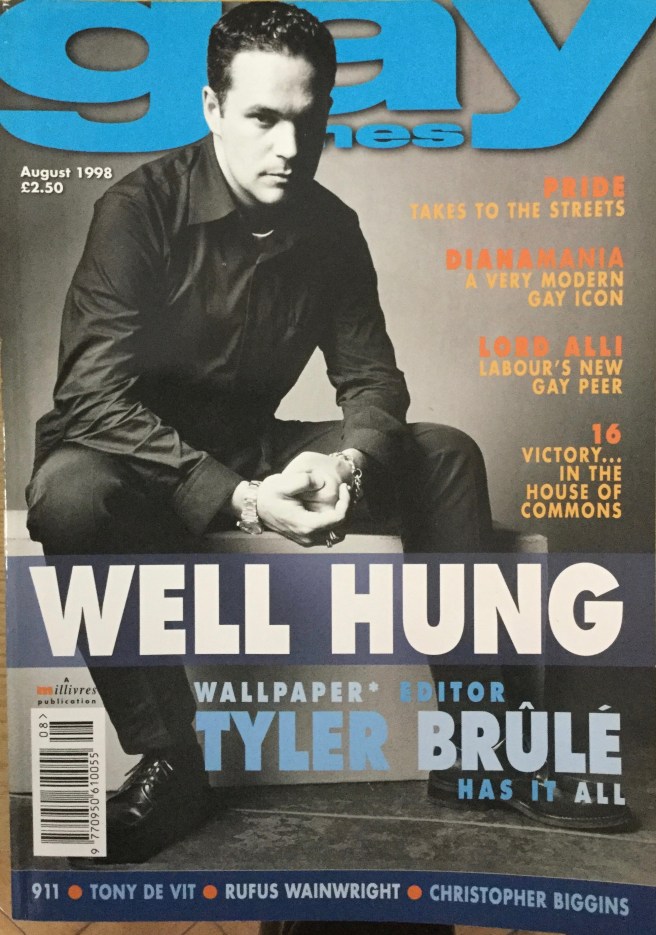
GAY TIMES, August 1998

Terry Sanderson’s autobiography “The Reluctant Gay Activist” is now available on Amazon https://www.amazon.co.uk/Reluctant-Gay-Activist-Terry-Sanderson/dp/B09BYN3DD9/ref=tmm_pap_swatch_0?_encoding=UTF8&qid=&sr=

Our famous victory in the Commons on June 22nd was long overdue [Note: MPs reduced the homosexual age of consent from 18 to 16.], but we must not lose sight of the fact that, although we may have won this particular battle, we are a long way from winning the war. We may have convinced the House of Commons — as yet we haven’t convinced the House of Lords — of the justness of our cause about the age of consent, but we certainly don’t seem to have convinced the country at large. Not if opinion polls are to be believed.

An NOP survey last year revealed that 53 per cent of the public are opposed to lowering the gay age of consent, while only 37 per cent supported it. Teletext did a phone vote on June 23rd, asking the question, “Do you support MPs who voted to lower the age of consent from 18 to 16?” There were 5,410 votes — 69 per cent said no, while 31 per cent said yes.

It can be argued that Parliament must lead public opinion and not follow it. Our representatives are supposed to examine the issues in detail on our behalf and make informed decisions about the wisdom or otherwise of legislation. We pay them to study the facts, listen to the arguments, weigh the implications, and then make decisions in the light of this knowledge.

We should be thankful that this is the brand of democracy we favour in this country, because if we made our legislative decisions by referenda, Britain would be a deeply unpleasant place to live. The frequent hysterical outbursts calling for hanging, flogging, castration and the sending home of “immigrants” give some indication of what I mean. Part of the reason for this social conservatism is, of course, that the majority of the population get their information from the media, and the majority of the popular printed media still has a very specific right-wing agenda. Tabloid readers are fed a daily mishmash of bigotry, ignorance, superstition, half-truths and plain propaganda.

Imagine if MPs had to depend on The Daily Mail or The Daily Telegraph for their information and advice. Imagine if Tony Blair took his lead from The Sun (and no cheap cracks about ‘he does, doesn’t he?’). Imagine if the only source of debate about the age of consent campaign had come from newspapers.

“This vile gay charter is wrong, wrong, wrong!” wrote Jim Sillars, a columnist on The Scottish Sun. “Homosexual relations don’t produce homosexual children who grow into prospective sexual partners for others like them. So there is no stock of homosexual young males. The answer is to legalise it and get the age as low as possible to ensure a continuous supply of sexual partners.”

Barmy? Extreme? You ain’t heard nothing yet. Take this, from Richard (“I’m not anti-gay”) Littlejohn in The Sun: “The momentum behind the age of consent campaign has come from predatory older homosexuals who like their sexual partners as young as possible —’chickens’, in gay parlance. The campaign to lower it still further to 14 is already underway.”

The Daily Telegraph editorialised. “Monday’s vote can be seen for what it really was: a licence for the exploitation of children, an attack on every parent in the land, and a disgusting act of hypocrisy by our ‘family-friendly’ Government … Prejudice against homosexuality is justified — not because homosexual men or women are wicked, but because the homosexual condition itself is usually an unhappy one, and one that no loving parent would wish on his child … The Government, and most MPs, fret about young boys buying fireworks, but have voted to allow them to be sodomised. Sooner than Tony Blair thinks, parents will come to view him with contempt for espousing ‘family values’ while effectively voting for child abuse. Their children have been set free — but before long, they will be everywhere in chains.”

Over in Scotland on Sunday, Gerald Warner wrote: “The paedophiles’ charter … legalising the sodomy of 16-year olds … was a slap in the face to every parent in Britain … The question our legislators should have asked is: will any young man’s life be ruined because he is not sodomised between his 16th and 18th birthday? If the Lords do not reverse this aberration by the Commons, there will have to be a campaign to repeal it under the next Government.”

And naturally, according to tradition, we had the ritual conjuring-up of Lynette Burrows, who, for some reason, is regarded as an expert on homosexual rights by the right-wing press. In The Sunday Telegraph she wrote, under the heading “Into the hands of paedophiles”, that 92 per cent of gay men in a Project Sigma study engaged in anal sex, or “buggery”, as she so lubriciously calls it. Having regaled us with this statistic, she turns her attention to homosexual group sex, and then makes a somewhat tenuous connection between those who have group sex and sinister paedophiles. She claims that when Holland liberalised its own laws, it resulted in the wholesale exploitation of young boys in pornography. “The paedophile sex industry is very big business in Holland and the lucrative trade in photographs and videos of young boys, for a world-wide market, is a magnet for men who specialise in staged group sex.”

The connection here eludes me, but Mrs Burrows is the expert, so what she says must be true. (By the way, Mrs Burrows is correct in saying that The Sigma report indicates that 92 per cent of gay men have had anal sex. She forgot to add ‘at some time in their life’, which doesn’t mean they have it all the time. Indeed, the report qualifies the statistic with the comment, “anal intercourse is not a particularly frequent part of the sexual repertoire, even among men who currently engage in the activity.” Come on, Lynette, dear, can’t you make your arguments honestly?)

And so the newspapers lined up in a fairly predictable way. The Telegraph, Mail, and Sun opposed the change with frightening determination. The Telegraph even went so far as to unearth last July’s infamous letter from Peter Tatchell to The Guardian, which made the case for an age of consent of 14, and then lead its front page with it on June 22nd: “Activists to push for gay sex at 14” was the bold headline. It was misleading to the point of dishonesty, but such are the familiar tactics of our opponents.

Indeed, apart from the personal opinion of Peter Tatchell (which he assures me he had not reiterated in the run-up to the debate), which was used as a merciless club to beat us with, the only other major source of ammunition was from the Church. “Bishops lead fight against moves to lower age of consent,” reported The Telegraph. Indeed, our 26 senior Holy Joes, led by their be-frocked and befuddled leader, George Carey, issued a statement that, “Pressures are at work to legitimise any and every lifestyle, irrespective of any difference of value and quality between them.” The bishops said they were concerned that the change would “send wrong messages to young people and society as a whole.”

It was at this point that those newspapers who took our side kicked in. Joan Smith in The Independent on Sunday spoke for many of us when she wrote: “I have had quite enough of bishops. I am tired of hearing their views on sex; I don’t want to know what the Church thinks I, or anybody else, should do in bed; I don’t care what the Bible has to say about homosexuality, fornication or masturbation. The phrase ‘I am a practising Christian’ is guaranteed, right now, to make me throw up.”

In The Independent, David Aaronovitch pointed up the stupidity of the idea that young men would abandon heterosexuality in droves now that they can practise “homosexual genital activity” at 16. “Are you saying that heterosexuality is so tedious, so unattractive that, given half a chance, the more red-blooded of today’s teenage boys would soon find themselves cracking whips over PVC-clad muscle men in Berlin? [Right-wing commentators] seem to believe that most of us are repressed homosexuals, nailed with difficulty to the narrow board of conventional family life. Speak for yourself boys.”

On the bishops and their “wrong messages” he asked: “What wrong messages? That we value gay teenagers as much as straight ones? That we believe that equality before the law will turn happy hets into homos? Or is George Carey’s concern perhaps that a whole load of those notoriously gay vicars will suddenly — and embarrassingly — turn from the basses and begin to proposition the altos in the church choir?”

The London Evening Standard changed sides — last time it was supportive, this time anti. Unexpectedly lining up in the gay corner, with The Guardian, Independent and Observer, were The Express and The Times. The Express, under its new editor, Rosie Boycott (previously of The Independent), has taken a definite leftward swing. This must be somewhat bewildering for its traditional readers, accustomed as they are to the kind of raving right-wing rhetoric that we’ve already seen from The Mail and The Telegraph. Ms Boycott has taken with her from the Indy John Lyttle, the virtually unreadable gay columnist, and rumour has it that other high-profile gay writers will follow.

The Times carried an extraordinary editorial on Pride day, giving its assessment of the current state of gay politics. The paper hopes that the community is not going to fracture in the way that the black community has in America. It draws parallels between those who want integration and those who want to preserve a separate culture. When this option was given to American blacks, it led to the forming of militant separatist groups like The Nation of Islam, which, the paper says, “may have enhanced black pride but only at the price of black prosperity. Gay politics here will soon stand at a crossroads. The real choice is between outreach and OutRage! It would not serve the majority of homosexuals well, in the words of Martin Luther King 30 years ago, to be equal but separate.” It was almost surreal to see The Times fretting itself over the welfare of the gay community.

No such sophisticated thinking, though, in the religious press. The Catholic Herald attempted to “name and shame” those religious MPs who had voted for equality. In an editorial, the paper accused the Catholic MPs and their Anglican colleagues, including the Prime Minister, of “betraying the people’s trust” and defying religious leaders. It said that the vote “marked a new low in this country’s slide into moral degeneracy.”

Over in The Church Times, Ken Batty, a gay Christian, was telling off the readership in an article entitled “Why do you pick on this sin only?” He wrote: “When I told my gay friends that I was a Christian, they reacted rather like the friends of a Jew who has revealed that he is a Nazi. They could not understand why I consorted with what they see as ‘the enemy’. And when I told people in my church that I was gay, they reacted rather like the friends of a Nazi who revealed to them that he is a Jew. Initially they marked me out as different, but eventually their discomfort became more open, and I felt forced to leave. I do not go to church any more. Disillusioned, I am happier at home. If they do not want me, then I do not want them.”

This is fine by me. I think all gay Christians should take the same line — then the Archbishop of Cant would know about it. Indeed, Mr Batty finishes by saying: “The commonest response among my lesbian and gay friends to Peter Tatchell’s invasion of Carey’s pulpit on Easter morning is to wonder why he bothered. Why should any gay person want anything to do with the church? The church wants nothing to do with us … I would like to agree with them. Only one thing stops me taking this view of the Church entirely. My partner of the past 14 years is a Church of England clergyman.”

Well, Ken Batty, why not get your partner round to the careers office and see if they can fix him up with a meaningful job that would allow him some dignity? Then he will be able to openly fight his bosses when they try to reverse the reform in the House of Lords.

And speaking of the bench of bishops, which, together with Lady Young and other Christian peers, is (as I write) drawing up plans to sabotage our hard-won amendment, perhaps they should take note of something written by a Cambridge professor of philosophy, Ralph Wedgwood, in a letter to The Times: “Although the lowering of the age of consent is not accepted by the majority of the people, it follows directly from a basic principle of human rights, which is accepted all over the world: the principle that it is wrong for governments to discriminate between classes of people without an uncontroversial and compelling justification. On the other hand, the traditional Church of England view that homosexuality is a sin is a sectarian religious position, which is not even accepted today by all Anglican bishops, let alone others, such as Quakers, Unitarians or Buddhists. When a sectarian religious view conflicts with a universal principle of human rights, it is clear which of the two should prevail.”

So stick that up your cassocks, your eminences, and leave us alone.

GAY TIMES 240, September 1998

What a month! From cheers to tears in the space of a fortnight. But how did it happen? How did a bunch of arrogant geriatric bigots manage to snatch the prize from our fingers? And how are we going to get it back? [Note: The amendment that would have reduced the homosexual age of consent from 18 to 16 had been passed in the House of Commons but was removed in the House of Lords.]

Make no mistake, our enemies know they have won a major battle, and they intend to capitalise on it in a big way. Mr Straw may have promised to restore the age of consent legislation at the first opportunity, but this time he’s going to find himself up against a formidable propaganda assault from rampaging religionists and self-styled protectors of the young.

In the House of Lords, Lady Young said that her campaign was supported by the vast majority of the population, and she cited an opinion poll, taken last year, which indicated that 73 per cent of respondents had opposed lowering the age of consent from 18 to 16. Polls taken after the Lords debacle painted a similar picture. In The Daily Telegraph (July 28th), a Gallup poll indicated that 65 per cent wanted the age of consent to “remain at 18”. An NOP survey reported in The Sun showed that 68 per cent were “against lowering the gay age of consent to 16”. Teletext asked its viewers to phone in and say “yes” or “no” to the question

“Do you agree with Dr George Carey’s view that legalising gay sex at 16 was ‘a grave error’?” Of the 7,000 or so who voted, 72 per cent said yes.

Yet we cannot take these polls at headline value. Analysis shows that younger people (those in the 18-24 age group) overwhelmingly support our call for equality, while those over 65 are very much opposed. But there is an anomaly. The Telegraph poll shows that general tolerance for homosexuals is growing. Gallup found that 42 per cent thought homosexual acts were “morally equivalent” to heterosexual acts (only 39 per cent thought they were inferior).

Maybe this is why there’s an alarming anti-gay frenzy being whipped up by the religious lobby around this issue; now unable to win their argument with rational debate, they’ve resorted to distortion, manipulation and sheer lies. And the right-wing press is happy to peddle it all with enthusiasm.

Lady Young, for instance, seems quite happy to play down her true motivations and keep her support network behind the scenes. She makes no secret of her Christianity. But what kind of Christian is she? Her choice of associates tells the whole story. Take the Rutherford Institute, for example, the legal arm of far-right US evangelists (see MediaWatch in the April issue of Gay Times for the full, sinister details).

The Rutherford Institute supported her during her attempts in the House of Lords to get religion exempted from the Human Rights Bill. She succeeded, by using anti-gay scare-mongering tactics. She never mentioned the Rutherford Institute during the whole of that campaign, even though they were pivotal in advising her.

I am not sure what part these undesirable American imports played in her age of consent campaign, but my suspicion is that they were pulling the strings somewhere in the background, because they have stated plainly that they intend to fight the advance of gay rights with everything in their power.

How does she get away with inviting raving US fundamentalists, with a specifically stated anti-gay agenda, effectively to interfere in our legislature? She is abusing her power and position, and she is doing it under the cloak of being reasonable.

Baroness Young is also closely associated with the fanatically homophobic Family and Youth Concern evangelical group, and at a press conference given in the House of Lords she was, according to The Independent, “flanked by two young men from the Christian Institute [another bunch of homophobic zealots], who handed out a pamphlet entitled ‘gay pressure on the young’”. Lady Young tries to present an acceptable face for this mish-mash of extremists. In reality, she acts as a rallying point for fanaticism.

But Lady Young and her covert crew aren’t the only ones beavering away to our disadvantage. On the day before the age of consent debate in the Lords, the Archbishop of Canterbury wrote in The Times that granting equality would be “a grave moral error”. He also tried to justify his new “muscular” stance by quoting Lady Young’s much-vaunted opinion poll. “Very many people in our land share our concern,” he said.

But claiming to speak for the people is a dangerous trick. After all, if he’s going to be consistent on this, Dr Carey is going to have to change his tune on the topic of euthanasia. After all, 82 per cent of the population support a change to allow death with dignity for the terminally ill (according to The British Social Attitudes Survey, 1996). Yet, the Lambeth Conference has just announced that the Anglican Church will never support euthanasia. Why not, George, given that “very many people in our land” want it legalised?

Carey says society is in need of “a strong moral framework — that is, one based on Christian principles.” If Dr Carey’s own behaviour is anything to go by, Christian principles leave a lot to be desired. He has said, for instance, that sex is reserved for married heterosexuals only, and that everybody else, gay or straight, must remain celibate.

But on the BBC, on July 26th, he was asked how he stood on the question of the growing number of heterosexual couples who were living together out of wedlock. Shifting in his seat, he said that many of these relationships were “akin to marriage” and advised them to tie the knot, but, significantly, did not condemn their co-habitation. The interviewer drew attention to his apparent contradiction — is sex strictly reserved for those in holy matrimony or isn’t it? Or is it just exclusively denied to homosexuals? So much for his claim not to be homophobic.

It is this kind of weasely squirming that makes Dr Carey look every bit the nincompoop he is. And I am not alone in thinking this. David Aaronovitch, in The Independent, wrote, “Carey’s position, when cleared of all the pompous penumbra [is that]… the equalisation of the age of consent will mean boys of 16 or 17 will become prey to the wiles of older men and, as a consequence, will be seduced into a lifetime of gayness when otherwise they might have grown up to be decent, God-fearing heterosexuals. It ain’t so, George.”

Aaronovitch says that he respects the Archbishop’s right to hold any opinion he wants, but not the power he has to inflict it onto other people by force of law. “Archbishop Carey has allied himself with the forces of intolerance and reaction, and is using his power as leader of the established Church to assist an unelected group of backwoodspersons to frustrate the decisions of the elected chamber… He hides the nature of his objection behind pomposity and presumption.”

Over in The London Evening Standard, Matthew Norman wrote: “Dr Carey is a blathering twit… Perhaps fearful of bringing on himself a truly appalling recruitment crisis, he eschewed stating plainly his apparent belief that gay sex is wicked in the eyes of God, and instead voiced his concern about the vulnerability of confused boys — an argument founded on the unchristian supposition that older gay men are marauding sexual vultures; and the illogical assumption that, where the sexuality of heterosexual 16-year olds is fixed, homosexual ones are just going through a phase.”

Meanwhile, at the Lambeth Conference, homophobia swirled out of control while denials of homophobia were issued seemingly on the hour. The Bishop of Mityana, Uganda wrote in The Independent that gays, like prostitutes, must be “brought to their senses… made to repent and be healed”. Another African bishop compared homosexuality with bestiality and child abuse. The Bishop of Akure, in Nigeria, said he would never meet gay Christians. He told The Independent: “I won’t listen to them, because it would be a sheer waste of time… As far as I’m concerned, it is against the word of God. Nothing — I repeat nothing — can make us African bishops budge, because we judge what God says as firm.” He then denied being a bigot.

But the influence of the ubiquitous US evangelists may be more pernicious than we ever imagined. The Daily Telegraph reported that “An advertising campaign by Christian political organisations, defining homosexuality as a curable ailment… pushed the ‘culture war’ to the top of the agenda of forthcoming elections. The White House accused conservatives of ‘gay-bashing’ for political advantage.” Indeed, the headline over the piece said it all “Homosexual ‘ailment’ fills vacuum in US politics.”

The Christian Coalition/Republican Party axis in America has realised for a long time that homosexuality is a “hot button” issue that it might be able to exploit successfully, and this was explored further in a major article in The Guardian about “the American backlash against gay rights”. The right-wingers are whipping up a humdinger of a reaction with clever tactics that appear to show “concern” for the “sick” people who are homosexual. They are using the “ex-gay” movement to great effect in their advertising. See — all these people have been cured of their sinful illness, which shows it’s just a perverted choice.

Maybe it is the same thinking which is leading to the revival of intolerant religion in this country. Perhaps, like his fellow religionists across the Atlantic, Dr Carey thinks gay-bashing can regenerate his own dying church. What, last month, we thought was our success story may turn out to be their success story.

The next year is going to be crucial, and the religious lobby is ready. They are fired up with their successes and they are now on an all-out crusade, not only to stop our progress but to push their own agenda. Mr Blair is going to find himself in a strange situation, caught squarely between his party’s liberalism and his own oft-proclaimed religious beliefs. How is he going to balance the conflicting demands of Stonewall and Lambeth Palace? Of Peter Tatchell and Baroness Young?

Peter Oborne, in The Daily Express, doesn’t think we can depend on him to keep his promises. “If the Prime Minister really cared about gay rights,” Mr Oborne wrote, “he would have instantly made it clear that the Commons was not going to be pushed around by the Lords on this vital matter of high principle… It is easy to see Mr Blair sitting down with his press secretary … and saying: “Let’s drop the gay vote, Alistair. And let’s blame the Lords.”

It is not the first time this has happened. Six months ago, the House of Commons voted by a huge majority to outlaw fox-hunting. Just as in the gay rights vote, New Labour MPs were near unanimous. Just as in the gay rights vote, the Prime Minister purported to be in favour. And just as in the gay rights vote, opposition in the Lords was used as an excuse for caving in. The question is often asked: what does Tony Blair believe in? No one has yet come up with a satisfactory answer.

Of course, he can’t “drop” the age of consent issue, because of rulings from Europe, but the repeal of Section 28 and other issues might be a different matter.

The next wave of anti-gay propaganda has already begun. The Daily Mail carried a two-page article on July 30th, with the headline: “At 16 he was lured into a homosexual affair with a much older man. Yet now Ian has a wife and child and knows he was never gay at all. What does he say to all those who want to lower the gay age of consent?” The same article reappeared, verbatim, in the following Sunday’s edition of The People, decorated with a ticker-tape headline saying: “Are you listening Mr Blair?”

It will get worse before it gets better. Can we depend on Tony to stand up to it and do what is right? Or is Baroness Young riding a tsunami

that cannot be stopped?

GAY TIMES October 1998

Terry Sanderson’s autobiography “The Reluctant Gay Activist” is now available on Amazon https://www.amazon.co.uk/Reluctant-Gay-Activist-Terry-Sanderson/dp/B09BYN3DD9/ref=tmm_pap_swatch_0?_encoding=UTF8&qid=&sr=

Now that the dust has settled, it’s time to look at what really happened at the Lambeth Conference, rather than what we were told happened. And there is convincing evidence that the rumour of a conspiracy by US evangelical churches to manipulate the agenda, and buy the voices of bishops from the developing world, has substance.

Ian T Douglas, the Associate Professor of World Mission and Global Christianity at the Episcopal Divinity School in Cambridge, Mass, has followed the process in some detail, and published his findings in the May edition of the US religious magazine, The Witness. It is a complex story, but also an object lesson in the way that US fundamentalists are conspiring to undermine everything that gay people have achieved in the past 20 years.

It began some five years ago, when concern was growing within Western Anglican circles that churches in the Southern hemisphere were not having a proportionate say in the development of the Anglican Communion. And so, a meeting, specifically for churches from the Third World, entitled the “South-to-South Conference of Anglicans”, was held in Kenya in 1994.

It was successful, and a further encounter was proposed for Kuala Lumpur in 1997. This was planned in North Carolina in 1995, at a conference called G-CODE 2000.

Ian T Douglas takes up the story: “Traditionalist Episcopalians in the US who helped fund and organise G-CODE 2000 began to appreciate the possibility of recruiting Third World church leaders to their position [on moral and sexual issues]. Specifically, William Atwood, rector of Trinity Episcopal Church in Dallas, a member of the G-CODE 2000 planning group and a donor to the conference, saw the gathering as a catalyst for his Ekklesia Society.

“Ekklesia was designed as an international network of Anglicans committed to ‘counteracting the negative impact of revisionist teaching which seeks to undermine the historic faith of the Bible and the’ Creeds’, and affiliated to the conservative American Anglican Council (AAC).”

The leadership of the emerging AAC was also involved, as was the Trinity Episcopal School for Ministry in Ambridge, Pennsylvania. And after the meeting in Kuala Lumpur, it emerged that the Episcopal Church had supported the gathering to the tune of $10,000.

The planners saw the choice of the Kuala Lumpur encounter’s theme, “The Place of Scripture in the Life and Mission of the Church in the 21st Century”, as the perfect means of chastising those in the West who take a pro-gay and lesbian stance. And it was thus no surprise that the ‘Second Trumpet from the South’, the report from the Kuala Lumpur meeting, should contain a statement in line with traditional standards of human sexuality.

The report, however, included little overt criticism of the West’s supposed “errant position” on homosexuality. It was mostly about the “crippling effects of international debt” and called on Western churches to put pressure on the international banking system to relieve it. The word ‘homosexuality’ occurs only once, but US evangelical spin doctors quickly set about making this the most prominent feature, turning it into “The Kuala Lumpur Statement on Human Sexuality”.

“Armed with the new abbreviated statement,” writes Ian T. Douglas, “traditionalists in the US were quick to use the voices of sisters and brothers in the South to advance their own aims. Conservative media soon misrepresented Kuala Lumpur as an authoritative, unanimous statement from all of the bishops in the Third World chastising the church in the US for ordination of gay and lesbian people and the blessing of same-sex unions.

“Because so many people in the Episcopalian Church, USA, are ill-informed and uneducated as to the realities [of Anglican politics]… such misinformation about the Second Anglican Encounter in the South was not challenged as to its truthfulness or its completeness. The fact that at least one participant at Kuala Lumpur— an archbishop, no less — spoke forcefully against the report’s statement on human sexuality was never mentioned in the press.”

As Mr Douglas puts it: “The sins of the new colonialism are not so much in the funding of the Second Encounter in the South, but rather in the West’s misuse of one article from the encounter report to fuel debates over sexuality in our own context.”

Soon after this, the Ekklesia Society organised another conference, in Dallas. Privately, the conservatives drafted a statement confirming what had been said in Kuala Lumpur on human sexuality. Ian T Douglas says: “What these drafters had not bargained for was that the Third World bishops, who were enjoying a free trip to the USA at the expense of the Ekklesia Society, had more pressing concerns than the West’s hang-up on sex, namely the sinfulness of Western capitalism… In a classic case of money for sex, the bishops from the Southern hemisphere traded their concern about international debt relief for the Americans’ statement regarding traditional ‘biblical’ norms of sexuality.

“What ensued was ‘The Dallas Statement’ linking the traditionalist agenda on human sexuality with the call for debt relief in Africa, Asia, Latin America and the Pacific. What many fail to realise, however, is that many of the African bishops who signed the ‘Dallas Statement’ embracing ‘biblical’ standards on human sexuality had been the key advocates at [the previous] 1988 Lambeth conference for a more accepting position on polygamy!”

As the Lambeth Conference approached, a group of US Episcopalian priests known as “First Promise” signatories, along with others in the American Anglican Council, gave $50,000 so that the bishops in the provinces of Burundi, Congo, Kenya, Rwanda, the Sudan and Tanzania could meet ahead of the Conference and plan tactics. They certainly got value for money. When the sexuality debate arrived, the African bishops spoke out in immoderate, one could almost say hateful, terms about homosexuals.

The Sunday Times then revealed that the AAC had been present at the Lambeth Conference, beavering away behind the scenes to ensure that they got the result they wanted — a vote reaffirming biblical opposition to homosexuality. Led by James Stanton, bishop of Dallas, the AAC gave pagers and mobile phones to bishops who were sympathetic to their cause. They could then call the AAC’s central HQ, which was based in a Franciscan Study Centre not far from the conference centre. There, 30 carefully trained volunteers provided points of instant rebuttal for use in the debate.

The Sunday Times said: “During the preparation of the resolutions, the American lobbyists were supplying bishops with arguments and powerful explanatory material to aid their case. In one preliminary discussion, a liberal bishop argued that homosexual orientation was something people were born with. As such, it must have been intended by God and was not, therefore, unnatural. Immediately, AAC researchers produced ‘medical evidence’ to show that people’s sexual orientation could be changed.”

Other right-wing American groups supplied traditionalist bishops with controversial pamphlets, one of which described homosexual sex acts in what was termed “pornographic detail, designed to make the flesh creep”.

Even The Church Times conceded in an editorial that: “For once, the conspiracy theorists are right. A close relationship had been forged before the Conference between bishops in Africa, Asia and Latin America and conservative bishops in the US… As for the further charge that the Americans had bought the Southern vote, there appeared to be a grain of truth in this, too. Though no cash changed hands at the Conference, as far as could be seen, the southern American states have offered to replace any money lent by the official Anglican bodies… There is a sense, then, that this Lambeth Conference was dominated by the internal politics of the American Church.”

We should not underestimate the far-reaching tentacles of US fundamentalists. Their influence is not restricted to the US. It is here and it is hidden, but there is now enough evidence of their activities to show that such thinking is not mere paranoia, and that there is genuine cause for concern.

GAY TIMES November 1998

Terry Sanderson’s autobiography “The Reluctant Gay Activist” is now available on Amazon https://www.amazon.co.uk/Reluctant-Gay-Activist-Terry-Sanderson/dp/B09BYN3DD9/ref=tmm_pap_swatch_0?_encoding=UTF8&qid=&sr=

Horrendous news! The Daily Mail, possibly the world’s vilest newspaper, now has Britain’s second-largest circulation, having overtaken The Mirror. Only The Sun now sells more.

In The Guardian, Decca Aitkenhead decided that the readership of The Daily Mail is mainly made up of Middle Englanders. She wrote: “Middle England has many sound virtues, but in my experience, tolerance is rarely amongst them. That is why it reads The Daily Mail.”

She goes on to say that Middle England will only accept those who play by its own rules. So “it’s OK to be gay, so long as you are in a stable relationship and do not pierce your penis. It’s OK to be black so long as you speak proper English and like Stevie Wonder. It’s OK to care about the environment as long as you buy your toiletries from the Body Shop, rather than live in a tree.”

She says that Middle Englanders have “imagination failure”. They are incapable of understanding why anyone would not want what they want.

Proof of this “imagination failure” in Middle Englanders came in The Daily Mail’s reporting of the story of a young Romanian man who has been given asylum in this country because of the persecution he would face if he returned to his native land. It demonstrated not only a lack of empathy, but a complete inability to show any human warmth or sympathy for people outside the magic, middle-class circle.

The man in question was 28-year-old Sorin Mihai, who was granted asylum by the Home Office because it believed that to deport him back to his own country would lead to him being persecuted because of his sexuality.

The Daily Mail didn’t like that at all. It has been agitating about Britain being “over- run” by foreigners for some time now, much as it did in the 1950s. In the first report on the subject, the paper enlisted MP Julian Brazier, chairman of the Conservative Family Campaign, to say: “We can offer people safe haven for being in a persecuted ethnic group or for political beliefs. I don’t think they should be offered asylum because they want to be practising homosexuals.”

Mr Mihai left Romania in 1994, at a time when same-sex relationships were totally against the law there. He says he received death threats, hate mail, and was spat at by his neighbours and arrested and assaulted by police. His family has disowned him.

A Home Office spokesperson refused to comment on individual cases, but told The Daily Mail: “A homosexual claiming persecution would have to come from a country where persecution is systematic or almost government-sponsored.”

Well, that’s Romania to a T.

Under intense pressure from the west, Romania recently changed its Draconian law, which gave almost automatic five-year prison sentences to gay people caught having sex. Now, with an age of consent of 18, gay sex is “legal” so long as it isn’t in public and doesn’t cause a “public scandal”.

The term “public scandal” can mean, of course, whatever the authorities want it to mean. If neighbours don’t like you, or if somebody wants revenge on you, they report you to the police, and “a public scandal” ensues. Then you can be sent to prison for five years.

In its report, Breaking the. Silence, Amnesty International said that torture and ill-treatment of gay people were common in Romania until quite recently. They report one victim of the regime, named loan, as saying: “I was sentenced to five years because of my homosexuality. It is terrible in jail. We were treated as if we were the most serious criminals. Everyone was treated better than homosexuals. When I was arrested, the police beat me and tortured me. In jail the torture continued, physically and emotionally. It was terrible. Even the neighbours inform the police. The police know everything about everyone.”

In another case, Doru Marian Beldie was arrested in Bucharest for a homosexual offence and was beaten by the police with truncheons on the palms of his hands and soles of his feet for several hours to make him sign a confession. He was sentenced to four and a half years.

The Daily Mail appears indifferent to this, and took up the story again on September 14th. The paper claimed that the capital city of Romania, Bucharest, has a “thriving gay scene”. It quotes Bogdan Honciuc of Accept, the gay rights group in Bucharest, as saying: “I am not saying that Romania is gay heaven but it is not gay hell either. Sorin can come home and relax… he is exaggerating a great deal if he says that he would be arrested. To say his life is in danger is not true. We can live here.”

Meanwhile, The Daily Mail’s reporter took a drive around what he called Bucharest’s “gay quarter”. There are two bars within 200 yards of each other — the Sherlock Holmes and the BU, which is a converted public lavatory. Also, there is cruising in the Opera Park nearby. This is The Mail’s idea of “a thriving gay scene”.

Mark Watson, Stonewall’s spokesman on immigration, confirms that there has been a slight improvement in Romania, but it is far from satisfactory, and pressure continues to be applied from the rest of Europe.

With typical spite, the paper seemed determined to have Sorin’s asylum rescinded and to have him sent back. It managed to get a Home Office spokesperson to say: “If evidence was produced to show deception had been used, then a case might be looked at again.”

So, with this case, The Daily Mail demonstrates what Middle England is: petty-minded, tight-arsed and (like Sorin’s squealing Romanian neighbours) routinely spiteful and malicious. Nothing gives The Mail a warmer glow than grassing up those it doesn’t like.

Matthew Norman, in The London Evening Standard, sent the whole thing up when he wrote “The granting of asylum to Sorin Mihai is shocking common sense and humanity from the Home Office… has this Government no respect for our country’s most cherished traditions at all?”

And before The Daily Mail pursues its hate campaign against refugees, it should take note of the case of Mariana Cetiner, who was given a three-year prison sentence in 1995 for alleged lesbian activity. While in prison she was ill-treated and beaten. She was released on an amnesty after serving 751 days of her sentence, and is now reported to have been granted asylum in Germany. There, the leading objectors to refugees and asylum-seekers are the neo-Nazis.

Maybe The Daily Mail should note the company it is keeping.

***

It would be unthinkable these days for any Prime Minister to be unmarried, and yet Edward Heath has managed to get through a long political career without much probing into the question: “How come you haven’t got a wife, Ted?”

Recent appearances in public do not give the impression that Mr Heath is any longer a passionate man. He sits there like a Madame Tussaud copy of himself, his face fixed and expressionless, his demeanour uncommunicative.

And yet there is one great rage in his life that we all know about — his seething hatred of Mrs Thatcher. His loathing for the now-shrivelled handbag-swinger is operatic in scale, and shows no sign of dwindling. So the great mandarin does have some feeling under that inscrutable exterior, even if it is malevolent.

His aversion to Mrs Thatcher is understandable, and shared by about 95 per cent of the population, but does it tell us anything about his feelings for women in general? The publication of his autobiography, and a television programme made to coincide with it, at last gave the newspapers legitimate cause to speculate.

The Times revealed that “A plot by Tory elders to bump Sir Edward Heath into ‘an arranged marriage’ with the celebrated concert pianist Dame Maura Lympany, while he was in office, is unmasked today.”

Apparently, the ludicrously-named Sir Tufton Beamish, who was a member of the powerful 1922 Committee of Tories, was “worried about Sir Edward’s bachelor status”. He approached Maura Lympany and said to her: “Maura, Ted must get married. Will you marry him?” She replied that if Mr Heath asked her personally, she would give the proposal serious consideration. Somehow, Ted didn’t quite get round to popping the question, and so Maura was spared the need to make the ultimate sacrifice.

In his recently published memoirs, The Course of My Life (the chapter about Mrs Thatcher is not entitled The Curse of My Life, by the way), he also intimated that he had missed the chance to marry his childhood sweetheart, Kay Raven. In the book, Mr Heath says, mysteriously, that he “knew her in so many different ways”. When she married someone else, he says, he was disappointed. “Maybe I took too much for granted,” he writes. What can it all mean?

In The Evening Standard, Andrew Billen tried to get a little further with the enigma and asked Heath whether he still gets annoyed when people ask why he never married. “I can’t stop them,” he replied, “but the TV programme was very silly. There were so many other things that we could have put into that programme. I spent 15 hours with them altogether. They became obsessed with it. I think there are a lot of things they simply don’t understand, so they can’t ask about.”

One of the things I don’t understand is that quote. What the hell does it mean? But it seems to have satisfied Andrew Billen, who wrote: “The question as to whether, despite his celibacy, Heath inclined to homosexuality, is put to rest in his memoirs by a pointed reference to a school trip to the Paris opera, during which he was distracted by ‘a delightful, fair-haired young lady’ whose shoulder straps ‘repeatedly slipped down in a most revealing fashion’.”

Meanwhile in his indiscreet diaries, serialised in The Sunday Times, we are told that the late Sir Woodrow Wyatt (who mixed only in the most exalted circles) was once at dinner with the Queen Mother when the topic turned to an artist they both knew who was unmarried and probably homosexual. “Do you think that’s true?” asks the old dear, “Lots of people say that about people who don’t get married but it isn’t always true.”

“No,” says Woodrow, “it isn’t true of Ted Heath.”

Unfortunately, he doesn’t expand on this remark, which is a shame but later on he does acknowledge that Mr Heath “doesn’t like women”. (Mr Wyatt also relates that Harold Macmillan, another Tory Prime Minister, was expelled from Eton for buggery, but that is by the by.)

Many readers will be saying: what does it matter whether Ted Heath is gay, straight or indifferent? Whose business is it, except Mr Heath’s?

Actually, it’s relevant to all of us. The reason that unmarried people are effectively debarred from the office of Prime Minister is because the political establishment does not want to risk the country being run by a homosexual. Unless we are prepared to lie, we can never attain the highest office in the land. Mr Heath, if he is gay, does us no service by keeping quiet about it.

It needs to be recorded that a gay person can hold the office of Prime Minister, and can hold it successfully.

GAY TIMES December 1998

Terry Sanderson’s autobiography “The Reluctant Gay Activist” is now available on Amazon https://www.amazon.co.uk/Reluctant-Gay-Activist-Terry-Sanderson/dp/B09BYN3DD9/ref=tmm_pap_swatch_0?_encoding=UTF8&qid=&sr=

It began quietly enough with The Daily Mail carrying a non-judgmental — even friendly — Hello!-style interview with the Culture Secretary, Chris Smith, and his lover, Dorian Jabri. “Being gay is simply one aspect of my life,” said Mr Smith.

This would have been remarkable enough in its own right, given the vicious anti-gay rhetoric with which the Mail usually fills its news columns, but, even as we were reading it, Ron Davies, the Welsh Secretary, was at Downing Street having his now-infamous meeting with the Prime Minister, tendering his resignation over his “serious lapse of judgment”.

Nice Mr Smith and his non-threatening partner were suddenly elbowed aside in favour of dirty Mr Davies and his visit to Gobbler’s Gulch, the fellator’s paradise on Clapham Common.

What followed was not only a grotesquely humiliating ten days for Mr Davies, but what Matthew Norman of the London Evening Standard called “one of the more spectacular news-management cock-ups of recent years”.

But Mr Davies and the Government have no one to blame but themselves for the scale of the explosion. Evasions and waffling simply spurred the tabloid press into a frenzy.

New Labour’s legendary media manipulation skills suddenly deserted them. “We don’t know any more than you do,” said Alistair Campbell to mystified journalists at the press briefing. This, too, turned out to be untrue, and Mr Blair paid the price by having the story extended for three more days and being subjected to accusations of lying. “Downing Street admitted yesterday that it did know about the background to the incident on Clapham Common before Ron Davies arrived at Number 10 to offer his resignation,” reported The Independent (and every other newspaper)

Oh what a tangled web we weave when we practice to deceive. And oh what pleasure and profit the tabloids gain from unweaving that web.

But Mr Davies’ personal tragedy suddenly became something more significant for all gay people. It unleashed once more the kind of press hysteria about homosexuality that erupts periodically in this country. This time it was slightly different. The Sun even assured us, in an extraordinary editorial, that the days of gay-bashing were over as far as it was concerned and that so long as you behaved yourself, it was OK to be gay.

Only an idiot would believe such an assurance from The Sun. On the same day that it declared a truce on gay-baiting, it carried a grossly homophobic rant from Richard Littlejohn.

But this was only the start. Just as the hysteria was beginning to abate, Mr Davies went to the House of Commons to give a personal statement aimed at halting the speculation about his private life. “We are what we are,” he said, paraphrasing the famous gay anthem (in the same way that Chris Smith oncedidin the House of Commons.)

But having failed to say what it is he is, he left everyone even more baffled. Worse still, he made the fatal mistake of blaming the media for his troubles. When will politicians ever learn?

Every aspect of Mr Davies private life has now been picked over in great detail, even the parts he thought no-one had seen (his many cottaging partners were paraded to tell their tales of fellatio on the M4 in The News of the World.) His first wife gave a full, frank and unnecessarily detailed account of her ex-husband’s many failings. We are also now aware that Mr Davies is well hung. It all made very sad reading.

But the press wasunrepentant. Don’t blame us for your pain, the said, we didn’t make you suck off those three men and then go looking for another one, who turned out to be a mugger and blackmailer.

The moral of this tale is: if you try to blame the media for your downfall, even if it is their fault (and in Mr Davie’s case, it wasn’t), they’ll rub your face in it.

There are sub-plots to this drama, perhaps the most entertaining being the resurrection of the outing issue. Just for the duration of Peter Tatchell’s absence in America,The Times columnist and former MP Matthew Parris, was presented as the chief promoter of outing after he asserted on Newsnight that the Trade and Industry Secretary Peter Mandelson is gay. No-one would have taken any notice if Jeremy Paxman hadn’t had a fit of the vapours over it.

Shrugging off suggestions that he was “sad and bitter”, Parris revelled in his new-found notoriety, writing self-justifying articles here, there and everywhere, insisting that there had been no malicious intention in his actions, he just assumed that everybody knew about Mandelson and that it wasn’t a secret.

There then followed another media spree, as the same mistake that Ron Davies had made was repeated by the high-ups at the BBC. Whereas Ron Davies had tried to stop revelations about his private life by obfuscating, the BBC tried to stop the Mandelson rumour by banning all mention of it.

In both instances, the result was to inflate interest to epic proportions. The ban lead to Alice in Wonderland style convolutions, such as the BBC newspaper review having to tell listeners that the papers were reporting the BBC ban on mentioning Peter Mandelson’s homosexuality – even though they were forbidden to do so on air. The panel on the BBC’s satirical programme Have I Got News for You talked of nothing else.

The press commentators then had a field day moralising once more on the rights and wrongs of outing. Stephen Glover in The Daily Mail began his ruminations by saying what just about everybody else said: “It’s none of my business”, but then went on at length about why Mandelson is so reluctant to come out. “One might say that there are Labour voters in Hartlepool [Note: Peter Mandelson’s constituency] and in the nation at large, who would rather Mr Mandelson were not a homosexual. I suspect that there are quite a lot of such people, and believe that Mr Mandelson suspects so too. Why does he not admit his homosexuality? Because he believes it might do him political harm. He understands that many people don’t accept a moral equivalence between heterosexuality and homosexuality. If he were a heterosexual, he would not refuse to talk about it.”

Mr Mandelson’s local paper The Hartlepool Mail, gave lie to that theory by conducting a poll which showed that 94 per cent of his constituents were indifferent to his sexual orientation. (The same thing happened in Ron Davies’s constituency. According to The Sunday Times, “Over 1000 letters of support have flooded into his constituency office… Last week a petition was organised calling for the disgraced Cabinet Minister to remain as an MP. In 90 minutes on a wet and windy Thursday morning in Caerphilly, more than 500 people queued in the main shopping precinct to sign the form.”)

George Walden in the London Evening Standard argued that Mandelson was under attack on all fronts – from the “Stalinists” in the gay community who want everybody out, whatever the cost, and both right and left of the straight community.

I said in Mediawatch in March that it was “only a matter of time before the tabloid hacks go for Mandelson’s sexuality in a big way.” Courtesy of Mr Parris, that time has come, and there can be few people in the country who are not now aware of Pete Mandelson’s sexual orientation, so why doesn’t he do himself — and the rest of us — a favour and stop this undignified spectacle once and for all?

Until he does, his tabloid tormentors will ensure that this story follows him around like a smelly fart. If he has any boyfriends, past or present, Peter can expect to read all about them one day on the front page of the newly “sympathetic” Sun.

This advice is not given in the spirit of “gay Stalinism”, it is sheer pragmatism. The muck-raking (or truth-telling) has started already in a minor kind of way in The Sunday Express, which carried an article headed “Brazilian student who is Mandelson’s close friend” — an innuendo-packed classic which suggested that Mandelson had some kind of “intimate” friendship with a young male student. A spokesman for Mr Mandelson apparently confirmed that the two were not “an item”, but the suggestion was clear — at some point they had been an item.

Mandy Mandelson is reportedly furious about all this. He has been sending his vituperative, threatening letters to all and sundry, according to Alan Watkins in The Independent on Sunday, and Watkins even claimed that Mandelson had demanded the BBC ban, which was ostensibly issued by Ann Sloman.

“At first it was thought that Ms Sloman acted entirely on her own initiative,” says Alan Watkins. “Now it is being claimed that her instruction flowed from a telephone call from Mr Mandelson to Sir Christopher Bland, the BBC chairman.” Why should Peter Mandelson have such power and influence? How did an MP for a small, northern, industrial community get the clout to demand —and get — a BBC black-out on comment on his personal life?

Mandelson continues to keep his silence in public, insisting that his private life is his own business and nobody else’s. Behind the scenes, he berates his influential friends into conspiring with him to keep his closet door locked.

But is he justified in this stance?

I think not, and for two reasons. The first was nicely expressed by the new Bishop of Liverpool, the Rt Revd James Jones, in an article in The News of the World. “Some people in public life think…what they do in private is none of anybody else’s business. But when people stand for election for public office, they are asking the voters to put their trust in them. Therefore, the character and trustworthiness of the person is a legitimate issue of public interest.”

This is the first (and probably the last) time I will ever agree with anything this nauseating right-wing clergyman says, but he’s spot-on in this instance. If Ron Davies, Peter Mandelson and, later, Nick Brown hadn’t been in the closet in the first place, these humiliations wouldn’t have happened to them or their party. All of them (and every other closet case in Parliament) have based their career on passing for straight, in other words on being dishonest with the people who elected them.

We are entitled to our privacy, they cry. Of course they are — but what exactly constitutes privacy in these cases? Does Tony Blair keep his sexuality “private”? Does he shag Cherie in a darkened room and then lock her away in the attic, hoping that she will never get out to sell her story to The News of the World? Did William Hague attempt to marry Ffion in private, away from the cruel gaze of Fleet Street? Did I just imagine reading about what a great time they’d had on their honeymoon? Is such stuff regarded as “private” for straight politicians? And, if Mr Blair doesn’t want us to know about the sexuality of his political colleagues, would he please stop walking around hand in hand with his wife and showing off his children, which must have been conceived in some sexual way — unless there was divine intervention.

Such ideas are ridiculous. But this is what Peter Mandelson and co are claiming should be private for them. Just the mere fact of their having a sexual impulse of any description is suddenly off-limits. Nobody is asking Robin Cook whether he likes to do it doggy-fashion with Gaynor, or whether she gives head. That, in my book, is private. Anybody should be able to close their bedroom door and be sure that, so long as what they are doing is legal, no paparazzi are peeping through the keyhole. But the mere fact of a person’s sexual orientation is not a scandal. It isn’t for heterosexuals, anyway, and it shouldn’t be for homosexuals. Indeed, for Chris Smith and Dorian Jabri, it isn’t. They are gay, they are happy with us knowing they are gay, and we are happy to leave it there. Nobody, not even The News of the World, follows them into their boudoir to check out precisely what it is they do in there.

This leads me to my second objection. By keeping their sexuality under wraps (and I’m talking about the fact of their sexual orientation, not the details of their sex life), Mandelson and other closet cases in public life are giving out the clear message that they are ashamed of what they are, that homosexuality is something to be kept secret (not private, secret), something unsavoury and disgusting. What kind of message is that for the rest of us, and for those “ordinary people” struggling with their own personal coming-out dilemmas? Peter Mandelson may say that he owes nothing to any other gay person. This is not true, and I know he knows it.

So, as far as I’m concerned, I don’t mind that people know about Ron Davies’s sexual orientation, or Peter Mandelson’s or Nick Brown’s, although I do despise the brutality and hypocritical self-righteousness of the tabloid outers. I’m just sorry that we had to be given so much sordid detail about Mr Davies’s activities.

Peter Mandelson can save himself from similar “exposure” by simply having the guts to say those three simple words: “Yes, I’m gay”. There’s no invasion of privacy there.

Although Matthew Parris was branded witch-finder general for his Newsnight performance, it is still the newspapers who are the chief outers. Tom Cruise and his wife Nicole Kidman won a huge libel pay-out from The Express after it stated that they were both gay and that their marriage was just a sham to protect their careers. Rosie Boycott, who was appointed editor after the articles appeared, then wrote: “As new editor of the Express titles (daily and Sunday), I would like to reassure you that I would not have published the articles.”

Which sounds OK, until you look at The Sunday Express the following day and see the article about Peter Mandelson and the student, which I’ve already alluded to, and which, according to The Guardian, was obtained by deception. We are entitled to expect more consistency from an editor who flaunts her ethical superiority.

And Nick Brown’s outing was not by Peter Tatchell or Matthew Parris, it was — if you look at the facts in a particular way — by Tony Blair.

The story goes that The News of the World was approached by a past boyfriend of Nick Brown’s anxious to sell them lurid tales of paid-for sex. The News of the World were unable to stand these stories up and so didn’t carry them. After the Davies and Mandelson debacle, the man went again to The News of the World and still the paper couldn’t find any evidence to back up what he said, so they went to Downing Street and told the Prime Minister what had happened.

Mr Blair then persuaded Nick Brown to make a statement admitting he was gay. This then became the story. The News of the World were just reporting the statement, see? They had no intention of outing Mr Brown on the say-so of the boyfriend.

Nick Brown was well-known as a gay man in Westminster (he has even been quoted, indirectly, in political news stories in Gay Times). Once again he asked for, and got, the collusion of his colleagues in keeping it private (i.e. secret). Now he’s paid the price.

Perhaps New Labour should take a leaf out of the New Conservatives’ book. According to The Sunday Express, the Tories are now actively encouraging gays to put themselves forward to local Tory constituency parties as potential parliamentary candidates. The Conservative Chief Executive, Archie Norman, has issued guidelines to local branches saying he wants to encourage more gays, blacks and women to be selected. “We want to choose candidates on their ability, irrespective of whether they are lesbian or gay… People have to be braver about it.” Wise words, indeed.

But both Ron Davies and Nick Brown can take heart from historical precedent. If we look back at previous “gay scandals” in the recent past, we see that, although it seems like the end of the world at the time, it seldom has lasting consequences. Indeed, it can sometimes enhance a career.

George Michael has a big new hit album on his hands since his cottaging conviction. And despite a prolonged and painful outing process, Michael Barrymore has just received the award for most popular entertainer for the fourth successive time. Both have been through similar tabloid beatings. They learned the hard way that there is a difference between privacy and secrecy, and in the end they triumphed by embracing two simple qualities: courage and honesty.

  • STOP PRESS: The Sun has announced (November 12th) that it will no longer “reveal the sexuality of any gays — men or women — unless we believe it can be defended on the grounds of overwhelming public interest.” The paper’s editor David Yelland, also revealed that he had sacked gay columnist Matthew Parris, the former Tory MP. Following his dismissal, Mr Parris questioned whether The Sun’s new liberal line would hold next time MPs debate the gay age of consent. “Then MPs’ private lives will be seen as a matter of public interest,” he told The Guardian.

Foreword to posts from 1999

Terry Sanderson’s autobiography “The Reluctant Gay Activist” is now available on Amazon https://www.amazon.co.uk/Reluctant-Gay-Activist-Terry-Sanderson/dp/B09BYN3DD9/ref=tmm_pap_swatch_0?_encoding=UTF8&qid=&sr=

As we headed towards the start of a new Millennium, the press homophobia was cooling somewhat. Public attitudes had changed out of all recognition. Opinion polls were beginning to show a more tolerant and accepting attitude among the public at large.

This was reinforced by a plethora of gay programming on television and much more thoughtful and sympathetic coverage in the sensible end of the press.

Despite this, the tabloids were finding it difficult to let go of their infantile approach, distorting not only the lives of gay people but creating hostility against other minority groups. People who had immigrated to Britain decades ago and regarded themselves as fully-fledged citizens with a big stake in the country, were suddenly being portrayed as aliens and threats.

This latent xenophobia, which had always, like homophobia, lurked just below the surface of British society was being stoked and encouraged by the tabloid press. The veneer of tolerance was wearing pretty thin.

However, we had yet to experience the full rage of the Islamist insurgency that was gathering pace in the Middle East. This really unleashed the illiberal streak in British society, and after the attack on New York on September 11 2001 and the fatwa against Salman Rushdie for his book The Satanic Verses, the Islamist threat mushroomed around the world.

Islamic attitudes to homosexuality were brutish and murderous and the struggle by Islamic conservatives to introduce more and more of their philosophy into Britain continues apace.

But gay life was improving step by step. Civil partnerships were granted, despite ferocious attacks from the churches and conservative elements in parliament. Equality legislation appeared that gave gay people protection against discrimination – again to the chagrin of the churches that lobbied hard for exemptions (and gained a few).

Interesting legal challenges arose as gay rights were pitted against religious rights and, at the time of writing, the legislation remains intact and undisturbed despite repeated court cases brought by fundamentalist Christians.

In the press there was a lot more sensible comment about homosexuality. The gay community began to admit that the boundaries between straight and gay were not as immutable as had once been claimed.

The final Mediawatch column was published in 2007 and since then gay rights continue to develop. In the USA, a right-wing populist administration is gradually rolling back some of the gains that gay people there had considered fixed and permanent.

In Britain, leaving the European Union has thrown much of the human rights agenda into the air once more. The battles are not necessarily over yet.

GAY TIMES January 1999

Terry Sanderson’s autobiography “The Reluctant Gay Activist” is now available on Amazon https://www.amazon.co.uk/Reluctant-Gay-Activist-Terry-Sanderson/dp/B09BYN3DD9/ref=tmm_pap_swatch_0?_encoding=UTF8&qid=&sr=

Doubt and confusion over homosexuality continues to reign in the British press. Are they for us or agin us? Indifferent to us or pruriently interested in our lives? Have they finished with outing, or is it just on hold?

One minute the papers are assuring us that being gay is no longer an issue, and the next they have hysterical headlines all over their front pages declaring this minister or that minister is gay (and at the same time assuring us that it’s none of our business).

The Daily Mirror editorialised that: “Everyone is entitled to some privacy in their lives. But those who go into public life should not hide anything as vital as their sexuality.” Interestingly, the paper’s readers didn’t agree. When asked to phone in and say yes or no to the question: “Do you want to know your MP’s sexuality?” 15,648 said “no” and only 9,676 said “yes”.

The public seems to be able to make a clear distinction between the Ron Davies case (with its lying, blackmail attempts and robbery) and the Nick Brown debacle, which was a straightforward News of the World speciality — a gratuitous outing.

In the midst of all this, The Sun told us that a gay Mafia was running the country, but almost immediately regretted doing so, as the rest of Fleet Street turned on the paper as one (something I’ve been waiting to see for a long, long time). “There is no velvet Mafia,” said The Guardian; while The Times assured us, “‘Gay Mafia’ is pure political fantasy”.

To show its contrition for being so stupid, The Sun then promised: “From now on The Sun will not reveal the sexuality of any gays — men or women — unless we believe it can be defended on the grounds of overwhelming public interest. If gays choose to come out, we will report it if we feel it is newsworthy or relevant. Otherwise we will not invade the privacy of gay people.”

This may seem like a breakthrough, but let’s not forget that The Sun signed up to the Press Complaints Commission’s Code of Conduct when it was first issued eight years ago. In the clause on discrimination, the PCC’s code says: “The press should avoid publishing details of a person’s race, colour, religion, sex or sexual orientation, unless these are directly relevant to the story.”

So, in fact, The Sun made the same promise not to drag gays out of the closet, all those years ago and has continually broken it. Why should it be any different this time?

The Press Complaints Commission itself took a lot of stick over the whole Nick Brown affair. You will remember that Mr Brown, the Minister for Agriculture, was quite gratuitously outed by The News of the World last month. Why was the press watchdog standing by doing nothing during such a period of blatant press disregard for its own code of conduct? Lord Wakeham, the PCC’s chief apologist, said that the PCC can only act if the person actually being persecuted complains. Understandably, the Minister did not feel inclined to put in a complaint, knowing that if he did, the whole thing would be raked over again.

The Press Complaints Commission is a waste of space. But worse than that, while it continues on its ineffectual way, it prevents anything more satisfactory being established.

However, help may be at hand. Erich Barendt, professor of media law at University College London, wrote in The Guardian that press outing may be illegal under the Human Rights Act which will come into force in January 2000. The Act guarantees the right of everyone to “respect for private and family life”, and this may be interpreted to mean that such cruel and unnecessary outings by newspapers may be illegal.

However, during its passage through parliament, the press managed to negotiate for itself a special privilege which gives extra weight to another clause in the Act, which guarantees “freedom of expression”, and so might be able to argue a public interest defence. It would have been interesting to know what a court would have made of the Nick Brown affair in the light of the Human Rights Act.

Meanwhile, the spotlight continues to shine on the fourth gay man in Mr Blair’s cabinet, Peter Mandelson. Unlike the others, Mr Mandelson has refused to comment on the “speculation” that he is gay and has done his best to silence all other public reflection on the matter. His biggest censorship coup — the BBC ban on commenting about his private life — is still in force, although very difficult to maintain, given the amount of newspaper interest.

It seemed for a while that Mandelson had managed to put an end to the murmurings that followed his Newsnight ‘outing’ by Matthew Paths. As far as he was concerned, his closet might have been bomb-damaged, but it was still intact. But then the bombardment started all over again when Punch magazine published a highly controversial account of Mandy’s visit to Rio de Janeiro earlier this year.

The magazine claimed that Mandelson had stayed at the home of British Council chief Martin Dowle and his boyfriend, Fabrizio Guzman. Unnamed “friends” and “chums” said that the three of them had spent a great deal of time cruising around “sleazy gay haunts”. Punch’s justification for the story was that a Minister of the Crown had behaved recklessly and foolishly while on an official visit paid for by the British taxpayer.

The Daily Telegraph was the first paper to pick up and run with this story on the front page of its first edition. But as soon as he heard about it, Mandelson was on the phone to Charles Moore, the editor, assuring him that it was all a tissue of lies. Mr Moore was convinced and pulled the story from subsequent editions.

Another apparent success for the Mandelson suppression-of-information machine.

Over the next few days, none of the other papers picked up the story in a big way, although the gossip columns were reporting that Westminster and Fleet Street were abuzz with gossip about the Punch revelations.

Just when Mandy thought he’d got away with it, William Hague gave the story new impetus, during the House of Commons debate on the Queen’s speech. Hague made reference to “Lord Mandelson of Rio”, an allusion that mystified most people —until the following day, when the papers decided they could maintain silence no longer.

With the excuse of the Hague reference, the papers were able to retail the Punch allegations while passing them off as criticism of William Hague for giving credence to “innuendo, lies and smears”.

Downing Street and Mr Mandelson were furious that the story was gaining wider circulation, and Mr Dowle was wheeled out, from Rio, to rebut the story.

He claimed he met Mr Mandelson from the plane and they’d gone back to Mr Dowle’s home and shared a bottle of wine before going on a sight-seeing tour to a baroque church, where a wedding was being held. “There was no nightclub. He was in bed by 10.30,” said Mr Dowle. He added: “I think that Peter and myself have been victims of a horrendous smear campaign that is like something out of Kafka. It is not clear who has been our judge, jury and prosecution,” he said.

But despite this strong denial, there has been no mention of legal action against Punch.

The Mail on Sunday added fuel to the fire by sending its own investigative team out to Brazil to try and find out what Peter really did in Rio. Being unable to track down any direct witnesses to Mr Mandelson’s alleged activities, The Mail was unable to make the Punch story stand up. At the same time — as Punch jubilantly pointed out —they weren’t able to shoot it down, either.

The Mail on Sunday said: “Mandelson’s dilemma continues. His vow of silence over his private life is born of a simple belief that it is purely his business and no-one else’s. But that may have changed now. For in blurting out those four cruel words, William Hague has ‘half-outed’ the Minister.”

By my reckoning, that means Mr Mandelson has been outed at least seven and a half times — and yet he still thinks he’s in the closet.

As we went to press, the new edition of Punch had just been published, which insists that its version of events is true. “The journalist who brought us the story is a hugely experienced investigative reporter with 25 years’ experience,” it says. “His sources on the story are impeccable and we remain confident that he got his facts right.”

The magazine criticised Mandelson’s “Sphinx-like silence” and thought that the strategy of non-comment was “looking less sound by the day”. It ended its report with the invitation: “Can we tempt you into the open now, Minister?”

The answer, of course, is no. But as I said last month, Mr Mandelson will never have a minute’s peace while his self-defeating stance continues. He will be relentlessly mocked by papers like The Sun, which carried a photograph of him, on an official visit, stepping out of a cupboard with the caption “Mandelson comes out of a closet (He really does!)”, and The Mirror, which showed him lifting a pink dumb-bell in a gym somewhere.

The problem is that Peter is not gay. Not officially, anyway. Perhaps he should give serious thought to this advice, proffered by Raymond Snoddy, also in The Times: “A role model is Chris Smith… who, has been, at least in recent years, open about being gay. Now nobody raises an eyebrow, and his partner is invited with him to attend official functions. He is an example that should be followed by any Cabinet ministers still in the closet. This would instantly remove temptation from the hands of newspaper editors —and, after all, why should consenting adults be embarrassed about expressing their true nature?”

In other words, Peter: for Christ’s sake, stop messing about and get out of that bleeding closet once and for all.

GAY TIMES March 1999

Terry Sanderson’s autobiography “The Reluctant Gay Activist” is now available on Amazon https://www.amazon.co.uk/Reluctant-Gay-Activist-Terry-Sanderson/dp/B09BYN3DD9/ref=tmm_pap_swatch_0?_encoding=UTF8&qid=&sr=

The closet doors have almost come off their hinges this month, such has been the traffic through them. Did you know, for instance, that Alan Donnelly MEP, leader of the Labour group in the European Parliament, has revealed that he is gay and living with a male lover?

You might have overlooked his announcement because it came on the same weekend that the Tory MEP Tom Spencer was caught by Customs coming home from a weekend in Amsterdam fully equipped with a stash of gay porn, a few joints and a kinky rubber fetish outfit. They didn’t find his hit of cocaine, but he owned up to it anyway.

Mr Spencer must have thought he had got off lightly when Customs officers decided not to prosecute him and gave him a £550 on-the-spot fine instead. The settlement, they said, would be confidential.

Confidential? Nothing is confidential to our all-seeing newspapers who, naturally, splashed details of the incident across their front pages. The focus of the story rapidly shifted from Mr Spencer’s attempted smuggling of illegal items to his homosexuality.

So, when he appeared outside his palatial home, tenderly embracing his wife, Liz, everyone expected the usual Tory routine of denials, cover-ups and unconvincing statements of love and affection between spouses.

But Mr Spencer had obviously learned the lesson. It’s no use trying to hide anything from the media pack, because if you do, they will — by hook or by crook — sniff out the truth for themselves. They will then gleefully feed the dirty details to their readers bit by bit, extending the humiliation indefinitely. Mr Spencer decided that the best way out was to answer all the reporters’ questions unequivocally.

In fact, both he and his wife were almost embarrassingly open about their relationship. Yes, Mrs Spencer said, she knew Tom was gay, she had known since before they were married. Yes, she knew he had affairs with other men, and she didn’t mind in the least.

The Fleet Street mob were fazed. This didn’t fit the picture. Why wasn’t she planning to write a book, like Margaret Cook had, to get revenge on her lying, cheating hubby?

Well, simply because he wasn’t lying or cheating. He told her all about his affairs, and even brought his boyfriends home from time to time, to meet the wife and daughters. Throughout all this, Liz Spencer smiled happily, and said that she and her hubby were the bestest of friends, always had been and always would be.

Then it was discovered that Mr Spencer’s latest boyfriend was a “muscle-bound American porn star” called Cole Tucker. Not only that, but he was “HIV-riddled” (as The Sun so charmingly put it). Now, thought the press pack, Liz Spencer will crack. Surely she’s going to go up in the air over this tasty morsel.

But no, Mrs Spencer continued to smile her rather charming smile and said: “When we married 19 years ago, we agreed that our relationship would always be the central relationship in our lives. But we agreed that from time to time he would feel the need to be actively gay. It’s quid pro quo — I have the same freedom, and it has been exercised, although I’m boringly straight. I’ve had an Aids test two or three times, but I can assure you I’m HIV-negative.”

Tom’s daughter Lorna was equally sanguine about the whole thing. “It doesn’t change my attitude towards him. I’m very open-minded and it doesn’t bother me at all. It won’t change the person he is.”

And what sort of person is he? Well, his family give him glowing testimonials for his warmth, generosity, openness, lovingness and his responsibility towards them. And you don’t feel for a moment that they’re saying it through gritted teeth. His colleagues have nothing but praise for the work he has done in the European Parliament and are sorry that this incident has wrecked a creative and useful career. In short, Tom Spencer is one of the few “outed” Tories that you wouldn’t mind having to dinner.

As Suzanne Moore in The Mail on Sunday wrote: “Their arrangement may not be everyone’s cup of tea but, compared to the ramblings of a Ron Davies or the humiliation of so many Tory wives, what emerges is a portrait of a modern, strange but wonderfully strong marriage.”

But despite Mr Spencer’s transparency, The Daily Telegraph couldn’t resist misrepresenting him. In an editorial, it said that the MEP was trying to make out that he was forced to resign by the Tories because of his homosexuality, rather than the fact that he had broken the law. “In much the same way, friends of Peter Mandelson liked to put it around that the former Trade Secretary was being hounded out of office because he was homosexual. They hoped to elicit sympathy for him on this account to divert attention from his real offence, which was to have unwisely borrowed a vast amount of money from a Cabinet colleague without telling anyone about it. The smokescreen didn’t save Mr Mandelson’s job, and now it has failed to work for Mr Spencer, too.”

This is simply not true. If anything, it is the other way round. Mr Spencer came clean about the smuggling (more than he had to) and it was the papers that made his sexuality the central pillar of the story.

Other countries, too, are finding that the media can be used to create events. In Czechoslovakia, the head of the secret service, Karl Vulterin, was sacked, apparently after a complaint from Christopher Hurran, the head of Britain’s MI6 station in Prague. It was felt that Mr Vulterin had mishandled the circumstances surrounding attempts to recruit an Iraqi diplomat to spy for the West and ruined a rare opportunity to penetrate the security surrounding Saddam Hussein. The diplomat was now on the run and fearful for his life and that of his family.

Mr Vulterin gained his revenge on Mr Hurran by having it announced on Czech television that Mr Hurran is a homosexual and lives in Prague with his Venezuelan boyfriend. This vengeful ‘outing’ was different to anything that happens on these lines in this country, because, of course, spies, by their very nature, need to be secretive.

So, is MI6’s policy of employing open homosexuals — confirmed in 1996 by Sir Gerry Warner, former deputy head of MI6 — simply ‘political correctness gone mad’? Or is there a place for uncloseted gay spies?

Oleg Gordievsky, a former KGB officer who spied for Britain, says (in The Sunday Telegraph) that the present relaxed policy on homosexuals with in MI6 is partly his doing. He advised MI6 that the Russians were no longer targeting homosexuals in the diplomatic service because they perceived Western attitudes to have changed to the extent that it was no longer possible to blackmail gays into treachery.

“Is that policy a terrible error of judgment?” asks Gordievsky. “In my experience, homosexuals can make excellent intelligence officers. These days they are no more vulnerable to blackmail than married men. They also cost the service less — since they do not have children whose education in expensive private schools the Foreign Office is obliged to pay for. There is absolutely no reason in principle to ban homosexuals, any more than there is a reason in principle to ban women.”

He does accept that there may be some postings to which homosexuals may not be best suited. “The Czech Republic is one of them — as are most countries in the former communist bloc. Attitudes to homosexuality there are akin to what they were in Britain in the fifties. Homosexuals are objects of ridicule. An openly homosexual intelligence officer would attract gossip and curiosity, most of it malicious.”

Intelligence gathering — or spying — is not an area that easily lends itself to equal opportunities. A female spy in a fundamentalist Islamic country would be ineffective because she would not be able to get anywhere near the power base. Equally, an openly gay spy would find it difficult to be effective in a grossly homophobic country. And as the intelligence that is gathered can mean the difference between life and death for so many people, we have to accept the world as it is, not as we would want it to be.

However, this argument can be taken too far the other way. In The Mail on Sunday, Mark Almond, a lecturer in modern history at Oriel College Oxford, attacked the Foreign Office for even contemplating including equal rights for homosexuals. “The men from the ministry are no longer the fuddy-duddies they used to be,” he sneers. “Private life once used to be compartmentalised from pin-striped day job. Not anymore. The Civil Service has been coming out all over.”

He then goes on to blame Mr Hurran for the plight of the Iraqi double agent. “It emerges that family and friends of the Iraqi defector face what one can describe politely as an uncertain future back home. Saddam’s reaction to treachery is well documented. And the defector himself, sitting in an MI6 safe house in Surrey, must be horrified at the outcome.”

But isn’t this where we came in? Wasn’t it the Czechs who mucked up the Iraqi operation, and wasn’t it Mr Hurran who tried to do something about their inefficiency? So why is he — or more correctly, his sexuality — being blamed for the whole catastrophe?

The Czechs may be sniggering about Mr Hurran’s sexuality, but that doesn’t let them off the hook for the disaster they have created with their stupid bungling.

***

There might have been surprises for those who were outed as homosexuals, but what of the shocking revelations of those who were outed as heterosexuals — the most startling being John (“I’m Free!”) Inman.

He might have made a career by playing the big Nancy with the tight trousers and the powder puff, leading people to assume, quite innocently, that he was gay. But you could have heard a sequin drop when The Express revealed that Inman has had a girlfriend (whom he describes as his partner) for 28 years. He won’t say who she is, of course.

So, if they were so close and passionate, how come he’s never married her? (At this point, sensitive readers may wish to avail themselves of a sick-bag before reading further.) “I have considered it,” says Inman. “I’ve often thought it might be nice, but you see I’m already married to a business they call show.”

Then there was the case of James Dreyfus, who is also making a tidy living out of playing the Nancy, firstly as PC Goodie in The Thin Blue Line and, more recently, in Gimme, Gimme Gimme on BBC2. Over at Elle magazine, he was being described as “the straight-in-real-life actor”. Could it possibly be the same James Dreyfus who gave a coming-out interview a week earlier in the Pink Paper? Obviously the folks at Elle don’t read the gay press.

But the most shocking of all was the headline in the The Express: “Gay Callow ‘true love’ for a woman.” According to the paper, “the theatrical world” will be rocked by the news that Our Simon “has admitted to an exhilarating and intensely passionate relationship with a woman”. In this instance, names are named. The lady in question is Peggy Ramsay, literary agent for such luminaries as Joe Orton and Alan Ayckbourn. Apparently, when Simon was in his thirties and Peggy in her seventies, they became totally besotted with each other (despite the fact that Simon was deeply in love with a young Egyptian gentleman at the time).

But you have to read to the end before you find out that it was a platonic affair. All the mad passionate expressions of undying devotion were those of friendship, not sexual obsession. Indeed, “our” Simon is still very much ours.

Meanwhile, The Sun’s gossip columnist, appropriately named Shaft, revealed that: “Two of the Premiership’s most gifted foreign footballers are having a gay affair.” He went on to say: “Shaft is happy for them. But in line with my strict no-outing policy, I won’t be releasing names on a team sheet.”

However, a few days later he claimed that he had been overwhelmed with requests to provide a few clues as to the identity of these soccer idols. No, he said. But later that week he wrote: “Nice to see one of our gay football mates out and about on Monday afternoon. Hampstead Village in North London is great for those that’s-frightfully-you boutiques, and you’re only a stone’s throw from the Heath.”

The Sun’s no-outings policy is beginning to develop cracks. How long before the urge to revert to type overcomes the boys at News International?

GAY TIMES April 1999

Terry Sanderson’s autobiography “The Reluctant Gay Activist” is now available on Amazon https://www.amazon.co.uk/Reluctant-Gay-Activist-Terry-Sanderson/dp/B09BYN3DD9/ref=tmm_pap_swatch_0?_encoding=UTF8&qid=&sr=

Contrary to popular opinion, there wasn’t a great deal of fuss about Queer As Folk in the tabloids. In fact, there was more space devoted to comment on how outraged the tabloids were than there was actual tabloid outrage. Any uproar that the producers of the drama serial had hoped for turned out to be quite muted.

Naturally, The Daily Mail didn’t want to disappoint its strange readers and brought in Lynda Lotta-Pee to pen the standard condemnation of (a) Channel 4 and (b) homosexuality. “Queer as Folk proves that we need censorship,” she wrote. “Certainly we shouldn’t be at liberty to watch naked actors having relentless homosexual sex.”

This kind of fulmination is traditionally the province of Paul Johnson, who could have knocked off the requisite 1,000 words of bile within seconds. Regrettably, this time round, we have been deprived of his profound insights.

The explanation for his absence from the fray came from Ben Summerskill, in The Express: “Only one red-faced polemicist will be missing from the roll-call of famous names participating in the denunciation [of Queer as Folk]. Paul Johnson, for years The Daily Mail’s ‘family values’ columnist, has gone strangely quiet since it emerged last summer that he had been carrying on an adulterous affair with a flame-haired floozie while lecturing the rest of us so sternly for almost two decades on the sanctity of monogamy.” Not that he would have needed to actually write anything. We know it off by heart.

And, of course, the TV critics of The Mail and The Telegraph thought the whole thing was straight out of the gutter and ought to be returned there forthwith. Peter Paterson, The Mail’s critic, wrote: “What is beyond comprehension is why C4 should have allowed this sordid material the unnecessarily long run of eight weeks (assuming that they do not bow to pressure and remove it before the eight weeks is up) and, more critically, why they needed to screen it at all.”

The pressure that Mr Paterson mentioned seemed to be centred on the Broadcasting Standards Commission, which claimed that it has received 30 complaints by telephone and a good many more by mail. So many, in fact, that it was instituting a special inquiry into Queer as Folk.

But what is the Broadcasting Standards Commission, anyway? And who are the people making the complaints? We know that Christian pressure groups have telephone trees and organise write-ins to TV stations whenever there is something gay on telly, and the BSC is usually quite good at politely telling them to get lost. So why has it risen to the bait this time?

David Aaronovitch in The Independent thinks: “The difficulty with the BSC may be… to do with its function. It is there to adjudicate on complaints, not to take a proper view of what is good and bad on television. So it is always the letter-writing pudendaphobes whose laments are being considered. Very few people put pen to paper (as well we might) to argue that, in fact, there is too little proper sex on television, and that ‘nudity levels’ are far too low. There are no erections (even late), almost no masturbation (despite its universality), and very little good foreplay.”

However, beyond the routine shrieking from the usual suspects, Fleet Street’s Department of Sanctimony had relatively little to say about Queer as Folk.

The real issues that the programme raised were, firstly, that some journalists don’t seem to be able to separate fact from fantasy and, secondly, that gay people don’t seem to be able to make up their minds how they want to see themselves represented on television — if, indeed, such a thing is possible.

Queer as Folk is drama. It is fiction, an invented tale. It is not a documentary. That may seem self-evident to sensible people, but right-wing journos are not as other people. They seemed to think that a real fifteen-year-old had been deflowered, and that actual anal intercourse had taken place in front of them in their living rooms.

Kevin Myers in The Sunday Telegraph wrote: “Queer as Folk was a self-indulgent, self-justifying delectation of the sodomisation of under-age boys. The events portrayed were criminal events, and even though the boy was shown as a ‘consenting’ partner, he was violated by an adult male who knew that he was just 15. Nor was there any admission that something monstrous was going on. Quite the reverse; buggery was seen as liberation, after which the boy was confidently indifferent to the sneers of his school fellows. Anal sex was merely a rite of passage.”

Myers also claimed that Queer as Folk’s portrayal of what he said “amounted to statutory rape” of the 15-year-old would “incite” gay men up and down the country to rush out and do the same.

Mr Myers then put forward the hoary old myth that young straight folk would abandon heterosexuality immediately when they saw how appealing gay life was (perhaps he was working on the assumption that Liverpool footballer Robbie Fowler had been watching the programme and that is what had caused him to invite Graeme Le Saux to “Come on, then, give it to me up the arse.”).

But Ben Summerskill in The Express had an answer for that one: “We have worked out for ourselves that if exposure to homosexuality made children gay, the Government wouldn’t need to take an axe to hereditary peerages. The aristocracy, almost all of whom attended all-boy boarding schools, would already have phased themselves out.”

In the story, the boy was a willing participant in the sexual activity — he had gone out looking for it. But, of course, in the prescriptive world of moralistic journalism, we are not allowed to even imagine that teenagers’ sexual feelings are legitimate, let alone that they might want to express them. No, those such as Garry Bushell, who have their own axes to grind, were anxious to present it as “paedophilia”, and upon mention of that word all sensible discussion goes out of the window.

Anyway, we don’t often hear the critics crying in such demented terms about the slaughter and violence which is the staple fare of TV drama. Where would all these interminable detective shows be without gruesome murders? Nobody objects to old ladies being strangled in Agatha Christie films, do they? If there wasn’t a murder, there wouldn’t be a case for Miss Marple or Hercule Poirot to solve.

That is to say, murder is an essential element of the drama. But witnessing its simulation on TV doesn’t make us all potential murderers. No-one is going to go out and start killing people because they saw Dawn French doing it in a comedy called Murder Most Horrid and thought it was a fun thing to do.

Similarly, if you are telling the story of a man who is a sexual predator, how can you possibly do it without alluding to his sexual behaviour? It’s an integral part of the drama. Plays involving straight sexual shenanigans go out every night of the week; there are naked men and women writhing and grunting just about every time you switch the telly on. The Broadcasting Standards Commission does not set up an enquiry every time a straight orgasm is simulated on TV. We can only deduce from this that the real objections to Queer as Folk are not that it is too sexually explicit, but that the sex involved is gay sex. Weasel words from Lynda Lee-Potter about gay people being just as offended as straight people won’t wash. We want to see our lives represented on television, even if it does have to be at an insultingly late time of night.

Having said that, I did think that the sex scenes were needlessly provocative and extended to the point where they were bound to cause controversy. They went on for maybe fifteen seconds too long for any convincing claim that they weren’t meant to get Middle England foaming at the mouth.

The man and his boyfriend had already discussed rimming, so did we really have to see tongue on bottom to get the idea? That’s the stuff of porn, not serious drama; but Channel Four needs the ratings, so the spunk had to be not just mentioned, but seen dripping from the actor’s hand.

Which brings me to the rather more important point about what gay people want from television programmes for and about them. Inevitably, after the first episode, there were accusations of stereotyping. “We’re not all heartless, predatory, cold queers who wouldn’t know intimacy if it punched them in the teeth,” wrote Boy George in The Sunday Express. “Sadly, gays on TV are either portrayed as fluffy and inoffensive or ruthless and imbalanced. What I want to see is a balanced view of gay culture. Queer as Folk is about as balanced as Myra Hindley and where does it take us in the struggle for equality, and more importantly, understanding?”

What George and others who cried foul over this programme forget is that characters in fiction are characters in fiction, they are not Everyman. The writer of Queer as Folk, Russell T Davies, tried to explain this in The Independent: “Who the hell wants their drama to be representative?” he asked. “That comes from the dull and sanctimonious desire to ‘do the right thing’. Writers who think ‘I must represent blind lesbians’ are on to a loser. Every other episode of Casualty is like that. People didn’t say about Cracker: ‘Does Fitz represent Scotland, or overweight people?’ All they said was: ‘He’s a brilliant character.’ The word representation shouldn’t enter the discussion of drama.”

So, there we are. Homosexuals will henceforth appear on television in all their irritating diversity, as individual characters, not as stereotypes or archetypes. We need characters behaving badly as well as nobly in order to have conflict. If there’s no conflict, there’s no drama. While we’re not all like the characters in Queer as Folk, neither are we all like Colin in EastEnders.

Queer as Folk may be brilliant, it may be crap, but it has at least taken us a step forward. It has opened the way eventually for there to be a series about gay people that will grip a wide, general audience. But before that can happen, we, the gay element in that audience, will have to relieve playwrights of their duty to endlessly propagate gay rights, and allow them free rein to create great entertainment.

GAY TIMES May 1999

Terry Sanderson’s autobiography “The Reluctant Gay Activist” is now available on Amazon https://www.amazon.co.uk/Reluctant-Gay-Activist-Terry-Sanderson/dp/B09BYN3DD9/ref=tmm_pap_swatch_0?_encoding=UTF8&qid=&sr=

Although it is supposed to police the newspaper industry, we should not forget that the Press Complaints Commission is set up and funded by that very same industry. Its code of practice purportedly guarantees redress for anyone who feels that they have been mistreated by newspapers. In reality, the code of practice is treated with contempt by newspapers, and the Press Complaints Commission ends up protecting the press from the people rather than the other way round.

Lesbian and gay people often take the brunt of Fleet Street’s lying; our lives are frequently subjected to the grossest invasions of privacy. You would think, then, that we could expect the most protection from the PCC. In fact, we receive next to none. Despite a clause banning the mentioning of a person’s sexual orientation unless it is “directly relevant to the story”, the outing of individuals continues in the tabloids. The PCC does nothing.

One small triumph came in 1998, during the first attempt by the Government to get the age of consent legislation through. American religious groups were flooding the country with bogus, or ludicrously exaggerated, statistics about gay men.

These were gleefully taken up by some newspapers, including The Sun, which allowed the holy-rolling Anne Atkins to say: “This is not opinion, it is fact: the life expectancy of a gay man without HIV is a shocking 43 years” and “a gay man is, alarmingly, 17 TIMES more likely to be a paedophile than a straight man.”

Fortunately, vigilant gay people were quickly on the case and complained to the PCC about this distortion. Ms Atkins and The Sun were found guilty of presenting conjecture as fact and received a rap on the knuckles in the form of a short adjudication, which the paper concealed as best it could.

I had hoped that that would be the end of these stupid statistics being printed as fact in newspapers. But of course, with another skirmish in the age of consent battle looming, our opponents just couldn’t resist the temptation to resurrect them.

A letter in The Daily Telegraph on January 27th, from Dr Hugh Thomson of Birmingham, claimed quite spuriously: “The mean age of death for homosexual males is 57 years (compared with 75 for married men), due to a whole variety of diseases, of which Aids is only one. A gay man is also more than 20 times more likely than others to commit suicide.”

I immediately shot off a letter to The Daily Telegraph, reminding them of the Atkins adjudication, and requesting that they allow me to correct Dr Thomson in their correspondence column. No response. And so I went to the PCC and asked them to intervene.

After prolonged correspondence and negotiation between myself and the paper, The Daily Telegraph eventually published a watered-down version of my letter pointing out that, as sexual orientation is not recorded on death certificates, and no-one can verify how many homosexuals there are in this country, there is no possible method — except guesswork — by which to arrive at the statistics quoted by Thomson.

The PCC succeeded in persuading the paper to publish my response, even though it was almost three months after the original letter had appeared. However, they were not prepared to take action to ensure the offence was not repeated. With another debate about the age of consent imminent, in the House of Lords, and aware that editors were likely to be tempted to employ these “statistics” again, I asked the PCC to remind newspaper editors of the previous ruling and ask them not to repeat the offence. I was told: “Only in cases involving harassment would the Commission be able formally to approach editors before publication. Of course, the Commission is most concerned for accuracy in reporting, but I fear it would be exceeding its function if it took the unprecedented step of guiding editors over their potential coverage of a particular issue.”

Exceeding its function? What exactly is the PCC’s function, if not to protect individuals and groups from spiteful propaganda and unwarranted intrusion? According to its own definition, the PCC’s purpose is purely the investigation of complaints. In other words, it makes no attempt at crime prevention, even if it sees the crime coming a mile off.

In The Guardian, Louis Blom-Cooper (who used to be chairman of the Press Council, the body that preceded the Press Complaints Commission) was asking a similar question. Is the PCC any use to anybody? And isn’t it time we came up with something a little more effective, like an independent organisation not run by newspaper editors?

As Blom-Cooper put it: “Although the Labour Party in opposition appeared to favour some action against the press, in government it has displayed a hands-off approach. Alliance with Rupert Murdoch has dictated a policy of non-intervention. Self-regulation in the newspaper industry has thus proved to be self-serving; it aims to protect the industry from anything that would impose responsible conduct on proprietors, editors and journalists and from an independent agency. It has palpably not served the public interest.”

* * *

From the department of innings and outings, we bring you news of celebrities who have this month exited the closet (or, in some cases, re-entered it).

First through the closet door, albeit posthumously and unwillingly, is travel writer Bruce Chatwin, who died from Aids several years ago. Everyone knew that Bruce was gay, but the man himself denied it to the day he died. Now a biographer has uncovered the whole truth about Bruce Chatwin’s sexuality and presented it for our delectation. His findings have been confirmed by Chatwin’s widow, who gave an interview to The Daily Mail about her husband’s partiality to other men.

Next out of the celestial closet is Camille Saint-Saens, the French composer who wrote The Carnival of the Animals. Unlike Bruce Chatwin, Saint-Saens’ closetry is understandable — after all, he lived in the nineteenth century, when discretion meant the difference between a full life or hard labour.

A new biography of Saint-Saens has just been published and in it the author, Brian Rees, stops short of saying that his subject was gay. But critics of the book are dismissive of such reticence. There is little doubt that Camille was homosexual, and in a review of the book in The Independent, Michael Church wrote: “Consider this letter, which Saint-Saens received when he was 35 and was suffering understandable pre-concert nerves: “Dear Friend, You make me ill with your fears. I used to think you a man; you are merely a coward… I thought I had brought up a man. I have raised a mere girl of degenerate stock.” The author of this tender missive was the composer’s mother, with whom he was still living. No biographer could ask for a clearer signpost.”

Perhaps even clearer signposts were that Camille liked to wear pink tights and sing falsetto at parties, and he once danced an impromptu ballet with Tchaikovsky, on the stage of the Paris Conservatoire. Add to this the later years spent in Algiers, where the climate (and the boys) was much more conducive, and the conclusion is inevitable. (Music lovers please note, Brahms was also outed in his most recent biography, so you can add him to the gay hall of fame, too.)

Over in The Sun, the brutish gossip columnist who goes under the pseudonym “Shaft” last month said that he knew of two gay footballers in the Premier League, and that he would give clues to their identity without actually naming them (outing being against The Sun’s stated policy). After a couple of weeks of teasing, the names were eventually discernible.

Now, the columnist says: “I hope to create more discomfort by announcing one of our most famous soap actresses is a lesbian. As an equal opportunities Shafter, I feel it’s only right that lesbians are given fair representation in my column. So the same rules apply — no names, no pack drill, but over the coming weeks I may be dropping Stan Ogden-sized hints as to her identity. Your starter for ten is that this woman, still a soap regular, once had a fling with Polly Perkins. And no, it’s not Pam St Clements.”

And I don’t think it’s Joy Brook, who plays DC Kerry Holmes in The Bill, either. Ms Brook was the actress who took part in the notorious lesbian shower scene in a recent episode. Those who were taken in by the tabloid hype about this scene were grossly disappointed when it was screened. To put it bluntly, it simply didn’t deliver on the promise — there was little discernible lesbianism!

Joy Brook, though, became so closely associated with the part that interest was stoked in her own private life, and eventually she admitted (in an article in Elle magazine) that she had had a lesbian relationship earlier in her life, with a woman called Alyson.

She describes their relationship as important, and romantic and lovely; and then explained: “Was it an ‘Oh my God, I was bisexual all along’ revelatory moment? I don’t think so. I still don’t think the word bisexual applies to me. It’s a label, a way of keeping people at a distance. I’ve always been with someone because I loved them, whether that person was a man or a woman.”

Now over to The Independent, which managed to secure an interview with Michael French, who played sexy hunk David Wicks in EastEnders and was subsequently outed by the tabloids. One can understand Mr French’s wariness in dealing with the press, but he’s promoting his new play and so it was a matter of needs must.

Has his experience at the hands of the Fleet Street outing merchants made him any less uptight about his sexuality? Not really. He says when he saw that front-page story about him and his boyfriend, he laughed. “I put it in the bin and I’ve never thought about it since. People made such a fuss about it, but have I ever publicly responded to it? No.”

True, he might not have responded to the allegations, but one can’t help but agree with interviewer David Benedict, who was more than a little unconvinced by French’s “bullish self-assurance” — it’s a rare person who could be so blasé about the sort of very public and humiliating outing he endured at the hands of the tabloids.

But French continues: “If I wish to have a relationship with someone, then that’s private and it always will be. They can write what they like. My job is to act, to entertain, that’s it.”

Meanwhile, The Daily Mail told us “The truth about Madonna’s lesbian loves”. According to J Randall Taraborrelli, Madonna told him: “I am not a lesbian” although she “admits to having fooled around with women from time to time”. The most famous pop star in the world added: “I thought it was undignified for me to say I wasn’t a lesbian, so when Sandra Bernhard and I were hanging out, I let people think what they wanted to think.”

The relationship — whether it was platonic or sexual is still not clear —ended acrimoniously, and now Sandra Bernhard says of Madonna: “That’s a woman who doesn’t have the vaguest idea who she is.”

But some gay relationships seem to be working. Both Michael Barrymore and Elton John have given interviews about their respective love lives, now that they’re all settled down with their respective Mr Rights. Michael Barrymore was splashed all over the front page of The Mirror. “My Gay Love. Shaun has made me happier than I’ve ever been. I wish I’d come out years ago,” screamed the headline.

Barrymore credits Shaun Davis with saving him from self-destruction. “Meeting him helped me sort myself out, made me see through all the confusion. He’s an honest, straight-down-the-line kind of guy with no side to him. He has been very strong and supportive.”

It’s a similar fairy tale for Elton John and David Furnish. In an interview with The Express, Sir Elton tells of “The man I love” — he and David have been together for five and a half years now and are still going strong. It was a touching interview, and the affection and esteem in which the two men hold each other came over loud and clear. “No one ever loved me as much as David,” says Elton. “No one ever gave me this kind of support and that’s the nicest thing I can say about him. He’s devoted to me and I’m devoted to him. It’s very hard for me sometimes — but he’s so loving towards me. It’s great.”

* * *

And finally, having started out with faked statistics aimed at demoralising us, let’s finish with more positive, and properly calculated, figures, in the form of a Mori poll of 1,003 people aged 18 and over, which was published in The Sunday Mirror on April 4th. In response to the statement “I would support my child if they told me they were homosexual”, 53 per cent of those polled “strongly agreed”, 29 per cent “tended to agree”, while 4 per cent “neither agreed nor disagreed”. Only 9 per cent definitely disagreed.

I wonder if Baroness Young is listening, and, if she is, whether she gives a toss?